Free profit tree template
A profit tree
that shows what to pull.
Profit is revenue minus costs. Split each side until every branch is a number someone can change.
Use it free — no card, no trial →
- Free forever — not a trial
- Up to 10 maps, kept for good
- Every export included
Free has no end date — upgrade only if you outgrow 10 maps. Opens with revenue and costs already split into customers, price, units, fixed and variable costs.
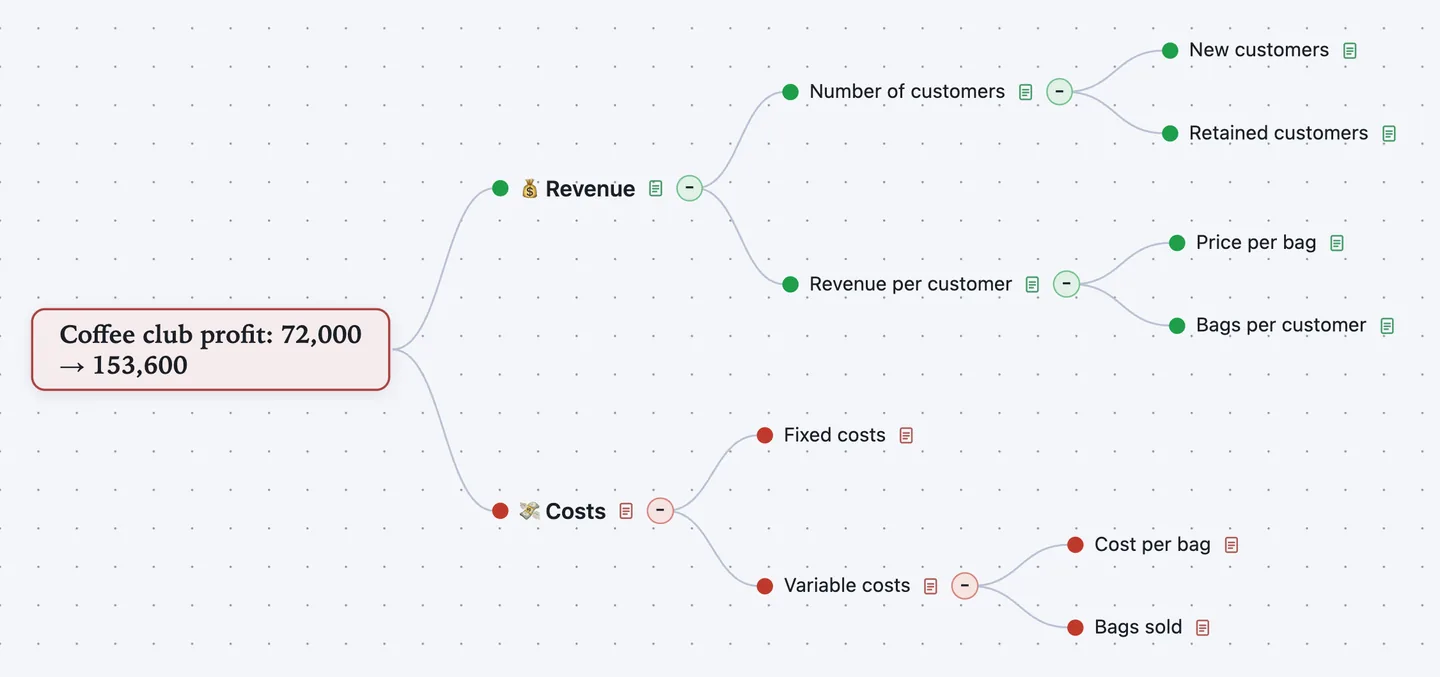
Every number has a parent. Revenue splits into customers and revenue per customer. Costs split into fixed and variable. You see how each driver reaches profit.
Current, target, owner. Each driver has a current value, a target, an owner and the lever that will move it.
One map for the review. Export it as slides, a PDF or an image. Markdown keeps the numbers as plain lines.
How to build a profit tree, step by step
A profit tree breaks profit into the drivers that produce it. It starts with one equation: profit = revenue − costs. Each side then splits again, until you reach numbers a team can act on. Consultants use it to find where profit is lost.
- Put profit at the centre. Use one period and one unit, such as profit per year. State the current figure.
- Split revenue. Revenue = number of customers × revenue per customer. Split customers into new and retained. Split revenue per customer into price × units.
- Split costs. Costs = fixed + variable. Variable costs = cost per unit × units sold. Add the cost lines that matter in your business.
- Check the arithmetic. Each parent must equal its children, by sum or product. If the numbers do not add up, a driver is missing.
- Fill in current and target. Write today's value and the goal on each driver. Atlas Red does not calculate the totals, so check them by hand.
- Name the levers. For the drivers with the biggest gap, write the action that will move them and give it an owner.
Worked example: a coffee subscription
A small coffee roaster sells beans by monthly subscription. Profit is 72,000 a year. The owners want to double it. The tree shows which drivers get them there. This is the map shown above.
- 💰 RevenueCurrent: 360000 · Target: 460800
- Number of customersCurrent: 2000 · Target: 2400
- New customersCurrent: 800 · Target: 900 · Owner: Mia · Lever: Referral credit
- Retained customersCurrent: 1200 · Target: 1500 · Owner: Jon · Lever: Offer a pause instead of cancel
- Revenue per customerCurrent: 180 · Target: 192
- Price per bagCurrent: 15 · Target: 16 · Owner: Mia · Lever: Raise price by 1
- Bags per customerCurrent: 12 · Target: 12
- Number of customersCurrent: 2000 · Target: 2400
- 💸 CostsCurrent: 288000 · Target: 307200
- Fixed costsCurrent: 120000 · Target: 120000
- Variable costsCurrent: 168000 · Target: 187200
- Cost per bagCurrent: 7 · Target: 6.5 · Owner: Sam · Lever: Buy green beans in bulk
- Bags soldCurrent: 24000 · Target: 28800
Read it bottom-up. 2,400 customers × 192 = 460,800 in revenue. 120,000 + 28,800 × 6.5 = 307,200 in costs. Retention is the biggest lever: 300 more kept customers bring in 57,600.
Let ChatGPT or Claude draft it
Connect Atlas Red to ChatGPT or Claude once. It is free. Then ask:
Make a profit tree in Atlas Red for this business: [describe what it sells, to whom, and this year's revenue and costs]. Use the profit tree template, split revenue and costs into drivers, and fill in current and target values.
You get the same template, filled in, in your own account. Fix what it got wrong by hand. Or ask for another round.
Questions people ask
What is a profit tree?
A tree that breaks profit into its drivers. Profit splits into revenue and costs. Revenue splits into customers and revenue per customer. Costs split into fixed and variable. Consultants use it to find why profit fell or where it can grow. It is a common framework in case interviews.
How do I use a profit tree in a case interview?
Start with profit = revenue − costs. Ask which side changed. Follow that side down one level at a time, with data at each step. Stop at the driver that explains the change. Then suggest levers for it. The tree keeps your reasoning in order and shows the interviewer your structure.
Profit tree or KPI tree — what is the difference?
A profit tree is one kind of KPI tree. A KPI tree, also called a driver tree or metric tree, can start from any number. Weekly active users, delivery time and cost per order all work. A profit tree always starts from profit. Both split a number into the drivers that move it. This template works for either: rename the root and branches.
Does Atlas Red calculate the totals in a profit tree template?
No. Current and Target are fields you fill in. Atlas Red does not add or multiply them for you. Check each parent against its children by hand, or ask ChatGPT or Claude to check the arithmetic.
Is this profit tree template free?
Yes. It is part of Atlas Red's Free edition: up to 10 maps, kept with no end date, every export included, no credit card. Pro is a one-time $99 payment for unlimited maps.
Can I export the profit tree to Excel or PowerPoint?
Not as an Excel or PowerPoint file. You get PDF, PNG, JPEG and SVG images, slides, an interactive web page, Markdown, OPML and plain text. Markdown keeps the fields as "Label: value" lines. It pastes into Word or Google Docs.