Free SWOT analysis template
A SWOT analysis template
that ends in a plan.
List your strengths, weaknesses, opportunities and threats. Back each one with evidence. Then link them into the strategies you will run.
Use it free — no card, no trial →
- Free forever — not a trial
- Up to 10 maps, kept for good
- Every export included
Free has no end date — upgrade only if you outgrow 10 maps. Opens with the four quadrants — strengths, weaknesses, opportunities, threats — already laid out.
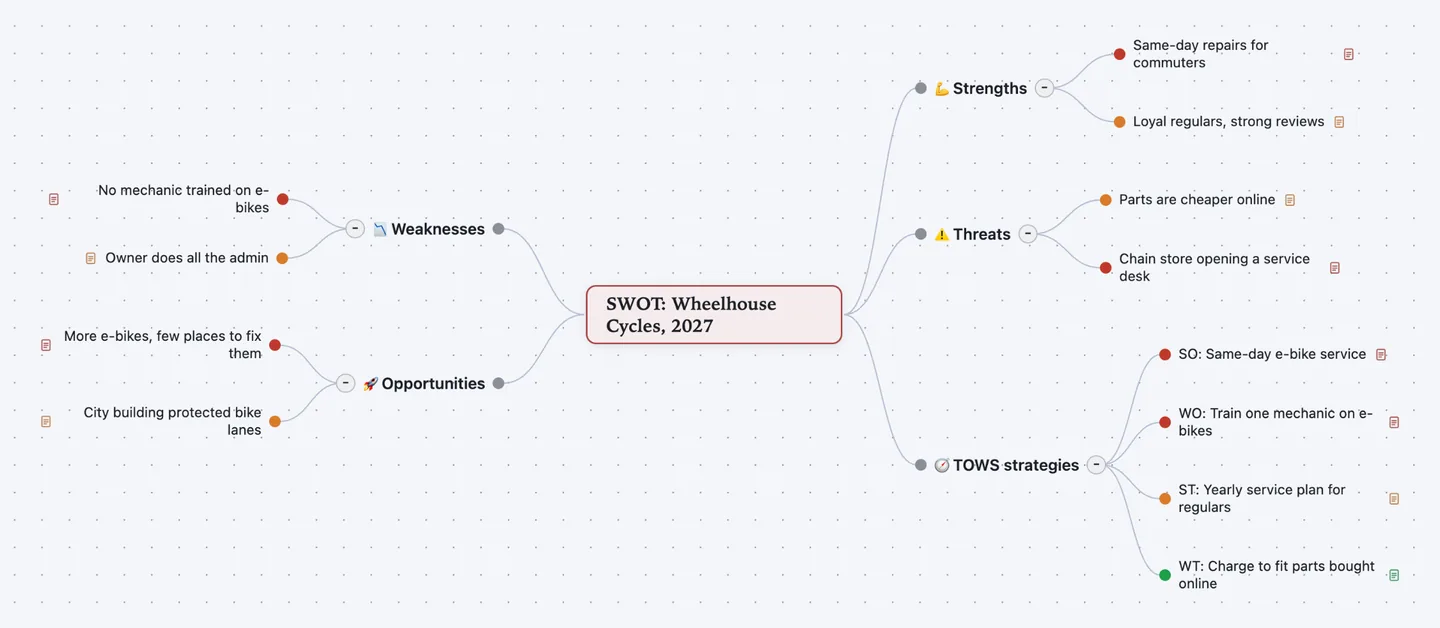
Back every point. Each point has an evidence field and an impact: low, medium or high. The list shows what matters, not only what came up.
Turn it into TOWS. Pair a strength with an opportunity, or a weakness with a threat, and write the strategy that follows. Draw a labelled link between the two.
Take it to the meeting. Export as a PDF, an image or slides. Markdown keeps every field and pastes into Word or Google Docs.
How to do a SWOT analysis, step by step
SWOT came out of business planning work in the 1960s; who invented it is disputed. It sorts what you know into four boxes. Strengths and weaknesses are inside your business. Opportunities and threats are outside it. The list is only half the job. The other half is deciding what to do about it.
- Name the decision. A SWOT needs a subject and a question: "our shop, before we add e-bike servicing", not "our business in general". It goes at the centre of the map.
- List strengths and weaknesses. These are things you control: skills, money, location, reputation, systems. Be honest about weaknesses — nobody else will read this draft.
- List opportunities and threats. These are outside your control: customers, competitors, prices, rules. A PESTLE scan or Porter's five forces feeds this half well.
- Add evidence and impact. For each point, write how you know it and rate its impact. A point with no evidence is a guess; mark it and check it, or drop it.
- Cross the quadrants (TOWS). Pair them up: strengths with opportunities (SO), weaknesses with opportunities (WO), strengths with threats (ST), weaknesses with threats (WT). Each pair suggests a strategy. Link the two points on the map so the reason stays visible.
- Pick and assign actions. Keep the two or three strategies with the most impact. Write the resulting action, an owner and a date. Look at the map again in three to six months.
SWOT analysis example: a bike repair shop
Wheelhouse Cycles is a two-person repair shop. The owner wants to know whether to start servicing e-bikes. Every point carries its evidence and impact, and the TOWS branch turns the four lists into four moves. This is the map shown above.
- 💪 Strengths
- Same-day repairs for commutersEvidence: Most jobs back by 6 pm, per job book · Impact: High
- Loyal regulars, strong reviewsEvidence: 4.8 stars from 300 reviews · Impact: Medium
- 📉 Weaknesses
- No mechanic trained on e-bikesEvidence: Turned away 9 e-bike jobs in May · Impact: High
- Owner does all the adminEvidence: About 8 hours a week on books · Impact: Medium
- 🚀 Opportunities
- More e-bikes, few places to fix themEvidence: Two shops sell e-bikes; neither services · Impact: High
- City building protected bike lanesEvidence: Council plan, works start in spring · Impact: Medium
- ⚠️ Threats
- Parts are cheaper onlineEvidence: Customers bring their own tyres and chains · Impact: Medium
- Chain store opening a service deskEvidence: Job ad for a bike mechanic, 2 km away · Impact: High
- 🧭 TOWS strategies
- SO: Same-day e-bike serviceResulting action: Launch once a mechanic is certified · Impact: High
- WO: Train one mechanic on e-bikesResulting action: Book the course for January · Impact: High
- ST: Yearly service plan for regularsResulting action: Draft the price and offer it in March · Impact: Medium
- WT: Charge to fit parts bought onlineResulting action: Flat fitting fee on the price board · Impact: Low
Each TOWS strategy names the two points behind it. In the app, draw a labelled link between those two points. A grid can't show that link, and it is the reason the strategy exists.
Let ChatGPT or Claude draft it
Connect Atlas Red to ChatGPT or Claude once. It is free. Then ask:
Make a SWOT analysis map in Atlas Red for [your business, product or yourself] before [the decision you face]. Use the SWOT analysis template and give each point evidence and an impact. Then add a TOWS branch with one SO, WO, ST and WT strategy. Link each strategy to its two points.
You get the same template, filled in, in your own account. Fix what it got wrong by hand. Or ask for another round.
Questions people ask
What is a SWOT analysis?
A review of a business, product, project or person under four headings: strengths, weaknesses, opportunities and threats. Strengths and weaknesses are internal — things you control. Opportunities and threats are external. It is used in business plans, marketing plans, school assignments and career planning.
What is a TOWS matrix, and how is it different from SWOT?
TOWS is the step after SWOT. Heinz Weihrich described it in 1982. You cross the quadrants to get four kinds of strategy. SO uses strengths to take opportunities. WO fixes weaknesses by taking opportunities. ST uses strengths to blunt threats. WT cuts weaknesses to avoid threats. This template has a TOWS branch for them, and you can link each strategy's two points on the map.
Is this SWOT analysis template free?
Yes. It is part of Atlas Red's Free edition: up to 10 maps, kept with no end date, every export included, no credit card. Pro is a one-time $99 payment for unlimited maps.
Can I export the SWOT analysis template to Word or PowerPoint?
There is no direct Word or PowerPoint export. Every edition exports PDF, PNG, JPEG and SVG images, slides, an interactive web page, Markdown, OPML and plain text. Markdown keeps your fields as "Label: value" lines and pastes into Word or Google Docs. A PNG or SVG drops onto a PowerPoint slide.
Can ChatGPT or Claude do a SWOT analysis for me?
They can draft one. Connect Atlas Red to ChatGPT or Claude — free, never metered. Ask for a SWOT map of your business. It builds the map from this template in your workspace, with TOWS strategies if you ask. Check every point against what you know. The assistant only knows what you told it, and it tends to list generic strengths.
SWOT or PESTLE — which should I use?
Both, in that order. A PESTLE analysis scans the outside world — political, economic, social, technological, legal and environmental change. Its strongest findings become the opportunities and threats in your SWOT. For a view of your industry's competition, add Porter's five forces.
Can I use it for a personal SWOT analysis?
Yes. Put your name and the decision at the centre — a job change, a promotion, a course. Strengths and weaknesses are your skills and habits; opportunities and threats are the job market, your company and your network. The TOWS branch then gives you a short list of moves.
What makes a good SWOT point?
Specific and checkable. "Same-day repairs" beats "good service"; "a chain is hiring a mechanic 2 km away" beats "competition". If you can't fill the evidence field, the point is a guess. Keep each list short — five strong points beat fifteen vague ones.