Free marketing mix template
A marketing mix template
with every decision in one place.
Product, price, place and promotion — plus people, process and physical evidence for a service. Write each decision, the evidence behind it, and whether it is settled.
Use it free — no card, no trial →
- Free forever — not a trial
- Up to 10 maps, kept for good
- Every export included
Free has no end date — upgrade only if you outgrow 10 maps. Opens with all seven Ps already laid out.
4Ps or 7Ps. The template has all seven. Selling a physical product? Delete people, process and physical evidence, and keep the classic four.
Track what's decided. Every item has a status — draft, testing or decided — and the evidence behind it. You see at once what is still open.
Check that it fits together. All seven sit on one map. A premium price next to a bargain-bin channel stands out. Export as a PDF, an image or slides.
How to build a marketing mix, step by step
Neil Borden coined "marketing mix" in the 1950s. In 1960 E. Jerome McCarthy cut it to four Ps: product, price, place and promotion. In 1981 Booms and Bitner added three for services: people, process and physical evidence. The mix is the set of choices you control to reach one target customer.
- Name the offer and the customer. One product, one target group: "online evening Spanish, working adults". The mix changes with the customer. It goes at the centre.
- Product. What exactly are you selling? Features, quality, format, what's included. Write what the customer gets, not what you do.
- Price and place. Price: the list price, discounts and how people pay. Place: where and how customers buy and receive it.
- Promotion. How customers hear about it and why they act: ads, posts, offers, partners, word of mouth.
- People, process, physical evidence. For a service, add the other three. People: who serves the customer. Process: the steps the customer goes through. Physical evidence: what they can see or keep that proves quality — reviews, a certificate, the website.
- Mark status and check the fit. Set each item to draft, testing or decided, with its evidence. Then read the map as a whole. Every P should suit the same customer.
Marketing mix example: an online Spanish course
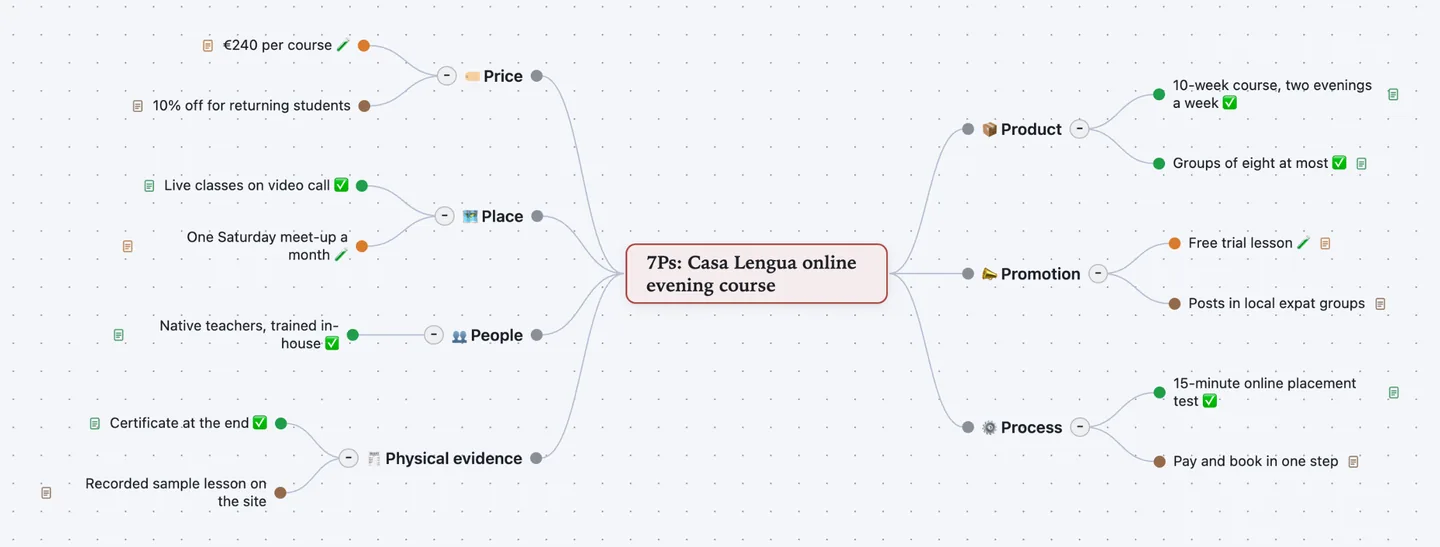
Casa Lengua is a small language school. It is launching a live online evening course for working adults. As a service, it uses all seven Ps. This is the map shown above.
- 📦 Product
- 10-week course, two evenings a weekDecision: Levels A2 and B1 first · Status: Decided
- Groups of eight at mostEvidence: Reviews praise our small classes · Status: Decided
- 🏷️ Price
- €240 per courseEvidence: Local rivals charge €220–€300 · Status: Testing
- 10% off for returning studentsStatus: Draft
- 🗺️ Place
- Live classes on video callDecision: Booked on our own website · Status: Decided
- One Saturday meet-up a monthEvidence: Students asked for it in feedback · Status: Testing
- 📣 Promotion
- Free trial lessonEvidence: Half of spring trials signed up · Status: Testing
- Posts in local expat groupsStatus: Draft
- 👥 People
- Native teachers, trained in-houseDecision: Same teacher all 10 weeks · Status: Decided
- ⚙️ Process
- 15-minute online placement testStatus: Decided
- Pay and book in one stepEvidence: A third quit at the old payment page · Status: Draft
- 🧾 Physical evidence
- Certificate at the endStatus: Decided
- Recorded sample lesson on the siteStatus: Draft
The status field shows the work left. Price and promotion are in testing. Four items are still drafts. The next meeting has its agenda.
Let ChatGPT or Claude draft it
Connect Atlas Red to ChatGPT or Claude once. It is free. Then ask:
Make a marketing mix map in Atlas Red for [your product or service] aimed at [your target customer]. Use the marketing mix template and fill in the 7Ps, or only the 4Ps for a physical product. Give each item a decision, its evidence and a status.
You get the same template, filled in, in your own account. Fix what it got wrong by hand. Or ask for another round.
Questions people ask
What is the marketing mix?
The set of choices a business controls to sell one offer to one target customer. The classic version has four Ps: product, price, place and promotion. The service version adds people, process and physical evidence, for seven Ps.
What is the difference between the 4Ps and the 7Ps?
The 4Ps — product, price, place, promotion — came from E. Jerome McCarthy in 1960. They fit physical products. In 1981 Booms and Bitner added people, process and physical evidence for services. In a service, the staff, the steps and what the customer can see are part of what they buy.
Is this marketing mix template free?
Yes. It is part of Atlas Red's Free edition: up to 10 maps, kept with no end date, every export included, no credit card. Pro is a one-time $99 payment for unlimited maps.
Can I export the marketing mix template to PowerPoint or Word?
There is no direct PowerPoint or Word export. Every edition exports PDF, PNG, JPEG and SVG images, slides, an interactive web page, Markdown, OPML and plain text. A PNG or SVG drops onto a slide. Markdown keeps your fields as "Label: value" lines and pastes into Word or Google Docs.
Can ChatGPT or Claude build a marketing mix for me?
They can draft one. Connect Atlas Red to ChatGPT or Claude — free, never metered. Describe your product and customer. It builds the map from this template in your workspace. Check prices and channels yourself. The assistant doesn't know your costs or your market.
Marketing mix or SWOT — which comes first?
SWOT first. A SWOT analysis tells you where you stand and which opportunity to chase. The marketing mix then sets out how you will chase it. A strength in the SWOT, such as small classes, often becomes a product decision in the mix.
What are the 4Cs, and do they replace the 4Ps?
Robert Lauterborn proposed the 4Cs in 1990: customer, cost, convenience and communication. They restate the 4Ps from the buyer's side. They don't replace them. Use them as a check: for each P, ask what the customer gets, pays, finds easy, and hears.