Free Porter's five forces template
A Porter's five forces template
that ends in a verdict.
Rate rivalry, new entrants, substitutes, supplier power and buyer power, with evidence. Then decide if the market is worth it.
Use it free — no card, no trial →
- Free forever — not a trial
- Up to 10 maps, kept for good
- Every export included
Free has no end date — upgrade only if you outgrow 10 maps. Opens with the five forces and a verdict branch already laid out.
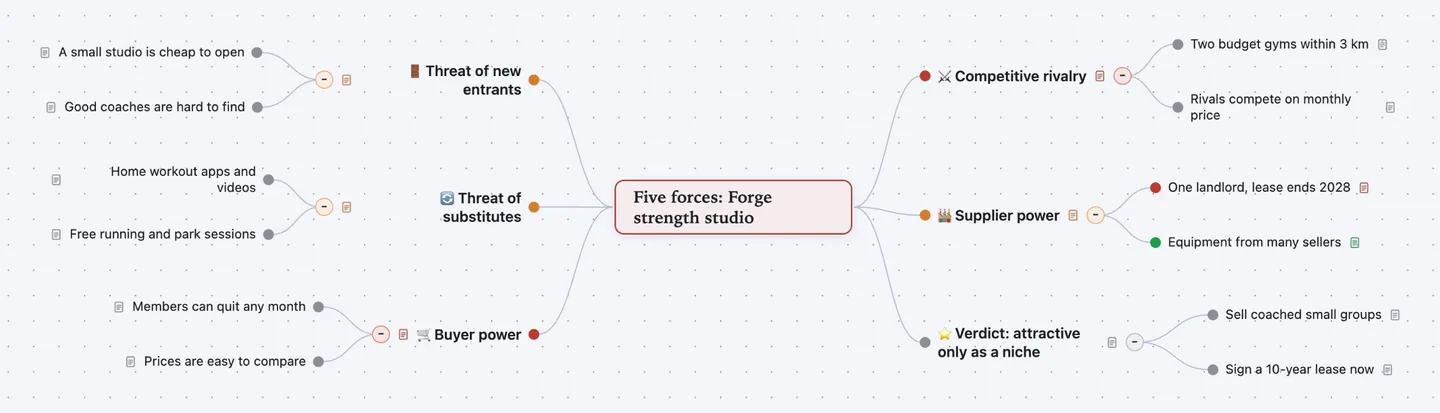
All five forces, ready. Rivalry, new entrants, substitutes, suppliers and buyers each get a branch. Add the reasons under each one.
Rate each force. Every force and reason has a strength — low, medium or high — and an evidence field. Strong forces squeeze profit.
Finish with a verdict. A sixth branch asks how attractive the market is and what you will do. Export it as a PDF, an image or slides.
How to do a five forces analysis, step by step
Michael Porter set out the five forces in the Harvard Business Review in 1979. His point: profit in an industry depends on more than your direct rivals. Suppliers, buyers, new entrants and substitutes all take a share. The stronger the forces, the less profit is left.
- Define the industry. Name the product and the area: "strength-training gyms in our town", not "fitness". Too wide and every force looks the same.
- Look at rivalry. How many competitors? How alike are they? Do they fight on price? Many similar rivals in a slow market means high rivalry.
- Check new entrants and substitutes. How hard is it to open a rival business? What else meets the same need in a different way? Low barriers or cheap substitutes cap your prices.
- Weigh supplier and buyer power. Suppliers are strong when they are few or hard to replace. Buyers are strong when switching is cheap and prices are easy to compare.
- Add evidence and rate each force. Write the facts behind each reason. Rate each force low, medium or high. Base the rating on evidence, not feeling.
- Write the verdict. Is the market attractive? Which forces hurt most? What can you do to weaken them? Put the answer and the moves in the verdict branch.
Porter's five forces example: a strength-training studio
Forge is a small strength-training studio in a town of 40,000. The owner is deciding whether to sign a longer lease and grow. Each force carries its rating; the reasons sit underneath. This is the map shown above.
- ⚔️ Competitive rivalryStrength: High
- Two budget gyms within 3 kmEvidence: Both open 24 hours, €20 a month
- Rivals compete on monthly priceEvidence: Joining fees dropped twice this year
- 🚪 Threat of new entrantsStrength: Medium
- A small studio is cheap to openEvidence: Used racks and a unit lease suffice
- Good coaches are hard to findEvidence: Our last hire took four months
- 🔄 Threat of substitutesStrength: Medium
- Home workout apps and videosEvidence: Leavers' survey: 1 in 4 went home
- Free running and park sessionsEvidence: Two clubs meet weekly in town
- 🏭 Supplier powerStrength: Medium
- One landlord, lease ends 2028Evidence: Few units in town with high ceilings · Strength: High
- Equipment from many sellersEvidence: Five quotes for new racks · Strength: Low
- 🛒 Buyer powerStrength: High
- Members can quit any monthEvidence: No contract, 30 days' notice
- Prices are easy to compareEvidence: All gyms list prices online
- ⭐ Verdict: attractive only as a nicheImplication: Don't fight budget gyms on price
- Sell coached small groupsImplication: Weakens rivalry and app substitutes
- Sign a 10-year lease nowImplication: Takes away the landlord's leverage
The ratings tell the story. Rivalry and buyer power are high, so the open gym market pays badly. Coaching is harder to copy, so the verdict points there.
Let ChatGPT or Claude draft it
Connect Atlas Red to ChatGPT or Claude once. It is free. Then ask:
Make a Porter's five forces map in Atlas Red for [your industry] in [your area]. Use the Porter's five forces template. Rate each force low, medium or high, with evidence and two reasons. End with a verdict and two moves.
You get the same template, filled in, in your own account. Fix what it got wrong by hand. Or ask for another round.
Questions people ask
What are Porter's five forces?
Five forces that decide how much profit an industry leaves for its players. They are competitive rivalry, the threat of new entrants and the threat of substitutes. The other two are the bargaining power of suppliers and of buyers. Michael Porter of Harvard Business School published the model in 1979. He updated it in 2008.
Is this Porter's five forces template free?
Yes. It is part of Atlas Red's Free edition: up to 10 maps, kept with no end date, every export included, no credit card. Pro is a one-time $99 payment for unlimited maps.
Can I export the Porter's five forces template to PowerPoint or Word?
There is no direct PowerPoint or Word export. Every edition exports PDF, PNG, JPEG and SVG images, slides, an interactive web page, Markdown, OPML and plain text. A PNG or SVG drops onto a slide. Markdown keeps your fields as "Label: value" lines and pastes into Word or Google Docs.
Can ChatGPT or Claude do a five forces analysis for me?
They can draft one. Connect Atlas Red to ChatGPT or Claude — free, never metered. Ask for a five forces map of your industry. It builds the map from this template in your workspace. Then check every rating. The assistant doesn't know your local rivals or your lease.
Porter's five forces or SWOT — what's the difference?
Five forces looks at an industry and asks whether it pays. A SWOT analysis looks at one business: its strengths, weaknesses, opportunities and threats. Run five forces first. Strong forces become threats in your SWOT; weak ones can be opportunities.
Is there a sixth force?
Some writers add complements — products that make yours more valuable, like apps for a phone. Others add government. Porter treats both as factors that shape the five forces, not as forces of their own. Add them as reasons under the force they affect.
Five forces or PESTLE — which do I need?
They look at different layers. PESTLE scans the wide world: politics, economy, society, technology, law, environment. Five forces looks at your industry: rivals, suppliers, buyers, entrants and substitutes. Many plans use both, then sum up in a SWOT.