Free issue tree template
An issue tree maker
for questions that matter.
Put one question at the root. Split it into parts that do not overlap and leave nothing out. Then test each part.
Use it free — no card, no trial →
- Free forever — not a trial
- Up to 10 maps, kept for good
- Every export included
Free has no end date — upgrade only if you outgrow 10 maps. Opens with three sub-questions, their drivers and a recommendation branch, plus fields for hypothesis, analysis and status.
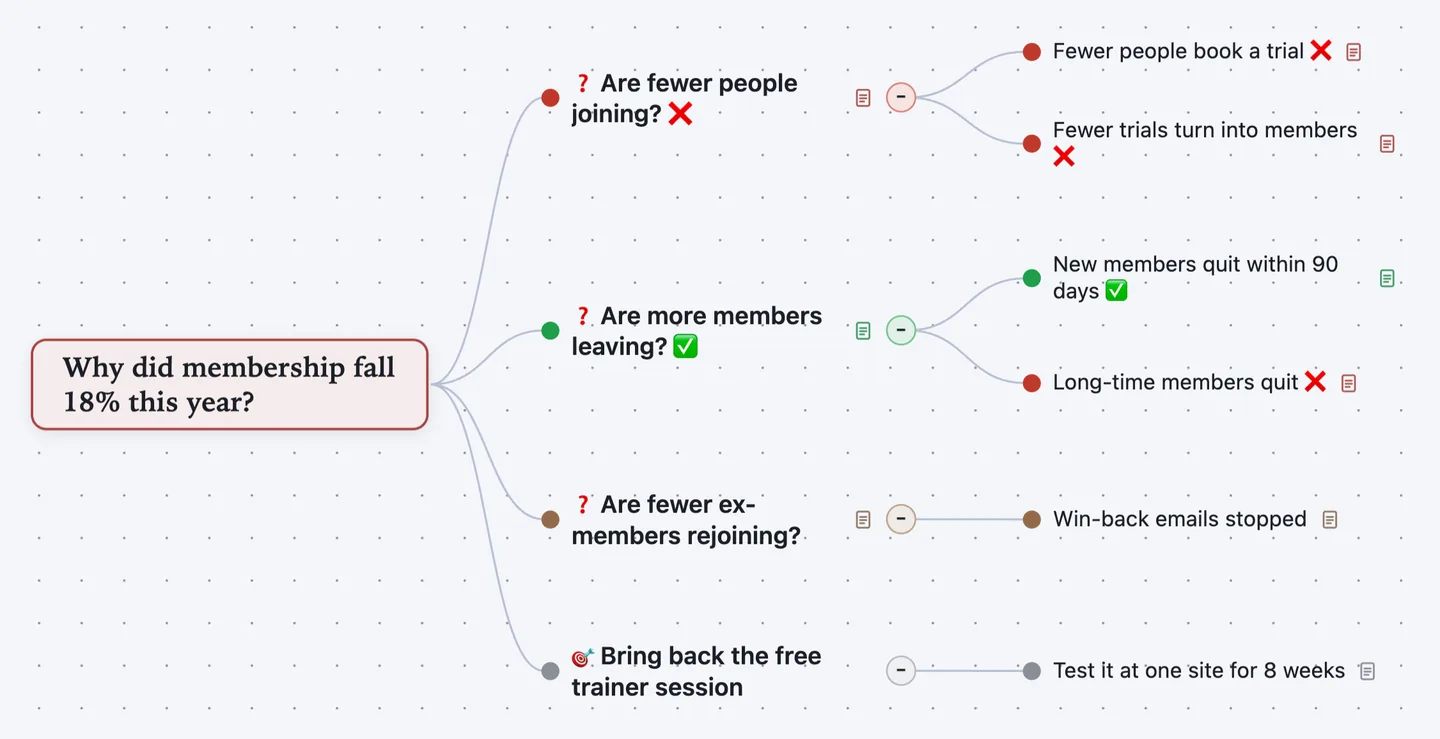
One question, split cleanly. Each branch answers part of the question. Together they cover all of it, and no two overlap.
Track every hypothesis. Each driver has a hypothesis, the analysis that tests it and a status: open, supported or rejected.
End with an answer. The recommendation sits on the same map as the evidence. Export it as slides or a PDF for the meeting.
How to build an issue tree, step by step
An issue tree is how consultants break down a problem. You write one key question. You split it into sub-questions, then split those again. Each split should be MECE: mutually exclusive (no overlap) and collectively exhaustive (nothing missing).
- Write the key question. Make it specific, with a number and a date if you can: "Why did membership fall 18% this year?" It goes at the centre.
- Choose the kind of tree. A diagnostic tree asks why something happened. A solution tree asks how to reach a goal. Do not mix the two in one tree.
- Split it the MECE way. Use a split that cannot leak, like a formula. Members = new joins + rejoins − cancellations. Each term becomes a branch.
- Go one or two levels deeper. Split each sub-question into drivers you can measure. Stop when a branch can be tested with one piece of analysis.
- Write a hypothesis on each driver. Say what you expect to find and which data would prove it. Give the analysis an owner.
- Mark the results. Set each driver to supported or rejected as the data comes in. Prune rejected branches from your story, not from the map.
- Write the recommendation. Answer the key question in one sentence. Then list the supported drivers that back it up.
Worked example: why a gym is losing members
A local gym ends the year with 18% fewer members. The team splits the drop into its three possible sources and tests each one. This is the map shown above.
- ❓ Are fewer people joining?Status: Rejected
- Fewer people book a trialHypothesis: Local ads stopped in spring · Analysis needed: Trial bookings by month · Status: Rejected
- Fewer trials turn into membersAnalysis needed: Trial-to-join rate, two years · Status: Rejected
- ❓ Are more members leaving?Status: Supported
- New members quit within 90 daysHypothesis: The free trainer session was cut in January · Analysis needed: Cancellations by months of membership · Status: Supported · Owner: Ana
- Long-time members quitAnalysis needed: Exit survey answers · Status: Rejected
- ❓ Are fewer ex-members rejoining?Status: Open
- Win-back emails stoppedAnalysis needed: Rejoins by month · Status: Open · Owner: Raj
- 🎯 Bring back the free trainer session
- Test it at one site for 8 weeksOwner: Ana
The three sub-questions cover every way a member count can fall, and none overlap. That is what makes the tree MECE. The open branch stays visible until Raj has the numbers.
Let ChatGPT or Claude draft it
Connect Atlas Red to ChatGPT or Claude once. It is free. Then ask:
Make an issue tree in Atlas Red for this question: [your key question]. Use the issue tree template, keep each split MECE, and give every driver a hypothesis and the analysis that would test it.
You get the same template, filled in, in your own account. Fix what it got wrong by hand. Or ask for another round.
Questions people ask
What is an issue tree?
A tree that breaks one question into smaller questions. The key question sits at the root. Each level splits the one above until every branch can be answered with data. Consulting firms use issue trees to plan the analysis on a project. They are also standard in case interviews.
What does MECE mean?
Mutually exclusive, collectively exhaustive. Mutually exclusive means no two branches overlap. Collectively exhaustive means the branches cover the whole question. The principle is linked to Barbara Minto and her pyramid principle, from her time at McKinsey. A formula is the safest MECE split: profit = revenue − costs.
Why use a mind map as an issue tree maker?
An issue tree is already a tree. A mind map lets you add, move and split branches without redrawing boxes. In Atlas Red each driver also holds a hypothesis, the analysis needed, a status and an owner. The map colours itself by status, so open questions stand out.
Can ChatGPT or Claude act as an issue tree maker?
They can draft the tree. Connect Atlas Red to ChatGPT or Claude and give it your key question. It builds the map from this template in your workspace. Then check every split for overlap and gaps. The assistant does not know your data.
Is this issue tree template free?
Yes. It is part of Atlas Red's Free edition: up to 10 maps, kept with no end date, every export included, no credit card. Pro is a one-time $99 payment for unlimited maps.
Can I export the issue tree to PowerPoint or Word?
Not as a PowerPoint or Word file. You get PDF, PNG, JPEG and SVG images, slides, an interactive web page, Markdown, OPML and plain text. Markdown keeps the fields as "Label: value" lines. It pastes into Word or Google Docs.
Issue tree or 5 whys — which should I use?
A 5 whys follows one chain of causes down, one answer at a time. An issue tree lays out every possible cause first, in MECE branches, and tests them all. Use the issue tree when the question is broad or costly to get wrong. Use 5 whys on a single failure.