Free literature map template
A literature map template
that shows where your study fits.
Group the studies you read by theme. Note each one's method, finding and limit. The gap your study fills shows up on the map.
Use it free — no card, no trial →
- Free forever — not a trial
- Up to 10 maps, kept for good
- Every export included
Free has no end date — upgrade only if you outgrow 10 maps. Opens with the research question, sources, methods, findings, gaps and next steps already laid out.
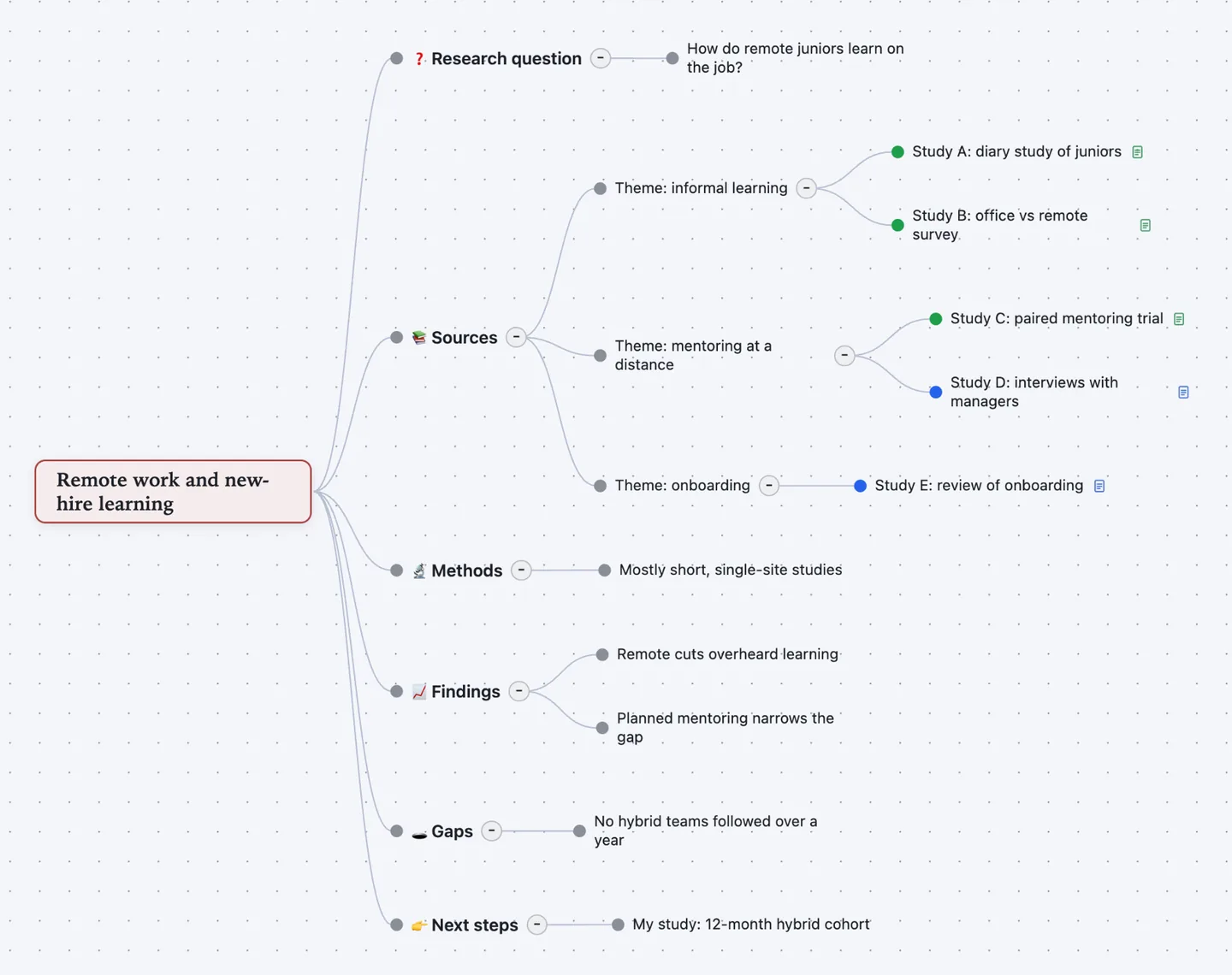
Studies by theme. Each theme is a branch and each study a topic under it. A study that spans two themes gets a link to both.
Five fields per study. Citation, method, key finding, limitation and relevance: core, supporting or peripheral.
From map to chapter. Each theme becomes a section of your review. Export the outline as Markdown and start writing.
How to make a literature map, step by step
A literature map is a picture of the research on a topic. John W. Creswell describes it in his textbook Research Design. Studies are grouped by theme, and the map ends with your own study and the gap it fills. Make it before you write the literature review.
- Write your research question. Put it at the centre. A rough question is fine; the map will sharpen it.
- Collect the key studies. Start with recent reviews and the most cited papers. Add each one as a topic with its citation.
- Group the studies by theme. Sort them into three to five themes. A theme is a shared question or idea, not a shared author.
- Note method, finding and limit. Fill the fields for each study. The limitations are where gaps hide.
- Link across themes. Draw a link when a study speaks to two themes, or when two studies disagree. Label the link.
- Name the gap. What has no one studied, or studied well? Write it in one line.
- Place your study. Add your proposed study under next steps and link it to the gap. That link is your rationale.
Worked example: remote work and new-hire learning
A master's student asks how junior staff learn on the job when they work remotely. Five studies sit under three themes. The studies are made-up placeholders to show the shape, not real papers. Swap in your own sources. This is the map shown above.
- ❓ Research question
- How do remote juniors learn on the job?
- 📚 Sources
- Theme: informal learning
- Study A: diary study of juniorsCitation: Author A (2021) · Method: Diary study · Key finding: Fewer chance questions when remote · Limitation: One company · Relevance: Core
- Study B: office vs remote surveyCitation: Author B (2022) · Method: Survey · Key finding: Remote juniors ask for help less · Limitation: Self-reported · Relevance: Core
- Theme: mentoring at a distance
- Study C: paired mentoring trialCitation: Author C (2020) · Method: Field experiment · Key finding: Set mentor slots helped · Limitation: Six weeks only · Relevance: Core
- Study D: interviews with managersCitation: Author D (2023) · Method: Interviews · Key finding: Managers find remote coaching harder · Limitation: Managers only · Relevance: Supporting
- Theme: onboarding
- Study E: review of onboardingCitation: Author E (2022) · Method: Literature review · Key finding: Structure matters more than place · Limitation: Few remote studies · Relevance: Supporting
- Theme: informal learning
- 🔬 Methods
- Mostly short, single-site studies
- 📈 Findings
- Remote cuts overheard learning
- Planned mentoring narrows the gap
- 🕳 Gaps
- No hybrid teams followed over a year
- 👉 Next steps
- My study: 12-month hybrid cohort
Notice where the gap came from. The limitation fields say one company, six weeks, managers only. No study follows hybrid teams for long. The student's study fills that gap.
Let ChatGPT or Claude draft it
Connect Atlas Red to ChatGPT or Claude once. It is free. Then ask:
Make a literature map in Atlas Red for my research question: [question]. Use the literature review template, group these studies by theme, fill in method, key finding and limitation for each, and name the gap: [list of studies].
You get the same template, filled in, in your own account. Fix what it got wrong by hand. Or ask for another round.
Questions people ask
What is a literature map?
A diagram of the research on a topic. Studies are grouped by theme, and the map shows how the themes relate and where the gaps are. John W. Creswell describes it in his textbook Research Design. It ends with your own study, placed next to the gap it fills.
How is a literature review map different from a literature review?
The map is the plan; the review is the text. A literature review map shows the studies, themes and gaps at a glance. The review is the chapter you write from it, one section per theme.
What should a literature map template include?
Your research question, the studies grouped by theme, each study's method, finding and limitation, the gaps, and your proposed study. This template adds a relevance field, so core studies stand out from supporting ones.
Literature map or synthesis matrix: which should I use?
A synthesis matrix is a table: studies in rows, themes in columns. It is good for comparing many studies on the same points. A literature map is better for seeing structure and gaps. Many students fill the map first, then export it as Markdown to build the matrix.
Is this literature map template free?
Yes. It is part of Atlas Red's Free edition. You get up to 10 maps, kept with no end date, every export, and no credit card. Pro is a one-time $99 payment for unlimited maps.
Can I export my literature map to Word or my thesis?
There is no Word or PowerPoint file. Every edition exports PDF, PNG, JPEG and SVG images, slides, an interactive web page, Markdown, OPML and plain text. Markdown keeps each field as a "Label: value" line, and it pastes into Word or Google Docs. Image exports work as a figure in a thesis or a proposal.