Free problem tree template
A problem tree template
from roots to results.
Name the core problem. Map what causes it and what it causes. Then turn each problem into the objective that solves it.
Use it free — no card, no trial →
- Free forever — not a trial
- Up to 10 maps, kept for good
- Every export included
Free has no end date — upgrade only if you outgrow 10 maps. Opens with branches for causes, effects and objectives, plus fields for evidence, priority and who is affected.
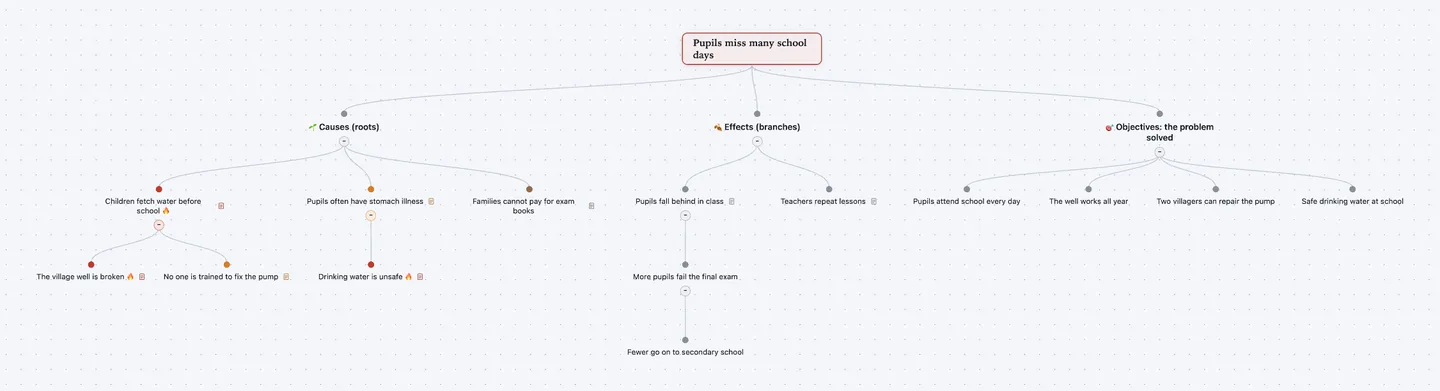
Causes and effects apart. Causes are the roots, effects are the branches. Each sits on its own side of the core problem.
Evidence on every cause. Each topic has fields for evidence, priority and who is affected. The map colours itself by priority.
Flip it into objectives. Rewrite each problem as the state you want. The objective tree sits on the same map.
How to do a problem tree analysis, step by step
A problem tree is a planning tool from development work. The core problem is the trunk. Its causes are the roots. Its effects are the branches. It is the first step of the logical framework approach, which many aid agencies and NGOs use to design projects.
- State the core problem. One negative condition, felt by real people: "Pupils miss many school days". Not a missing solution, like "No new school".
- List the direct causes. Ask what leads to the problem. Each answer becomes a branch under causes.
- Dig to underlying causes. Ask why of each direct cause. Stop when you reach causes the project could act on.
- List the effects. Ask what happens because of the problem. Add direct effects, then the long-term effects they lead to.
- Check it with the people affected. Run the tree in a workshop with them. Add evidence to each cause and set a priority.
- Flip it into an objective tree. Rewrite each negative as a positive. The core problem becomes the purpose. Causes become means; effects become ends.
Worked example: pupils missing school
A rural school district sees pupils miss many days. A local NGO maps why, and what it leads to, before it plans a project. This is the map shown above.
- 🌱 Causes (roots)
- Children fetch water before schoolEvidence: Parent survey · Priority: High · Who is affected: Girls aged 10–14
- The village well is brokenEvidence: Site visit · Priority: High
- No one is trained to fix the pumpPriority: Medium
- Pupils often have stomach illnessEvidence: Clinic records · Priority: Medium
- Drinking water is unsafeEvidence: Water test · Priority: High
- Families cannot pay for exam booksPriority: Low · Who is affected: Poorest households
- Children fetch water before schoolEvidence: Parent survey · Priority: High · Who is affected: Girls aged 10–14
- 🍂 Effects (branches)
- Pupils fall behind in classEvidence: Term test scores
- More pupils fail the final exam
- Fewer go on to secondary school
- More pupils fail the final exam
- Teachers repeat lessonsWho is affected: Teachers and other pupils
- Pupils fall behind in classEvidence: Term test scores
- 🎯 Objectives: the problem solved
- Pupils attend school every day
- The well works all year
- Two villagers can repair the pump
- Safe drinking water at school
The objectives mirror the causes. A broken well becomes a working well. The NGO cannot fix every cause, so it picks the high-priority ones for the project.
Let ChatGPT or Claude draft it
Connect Atlas Red to ChatGPT or Claude once. It is free. Then ask:
Make a problem tree in Atlas Red for this problem: [describe the problem and who it affects]. Use the problem tree template, list causes two levels deep, add the effects, and flip the main causes into objectives.
You get the same template, filled in, in your own account. Fix what it got wrong by hand. Or ask for another round.
Questions people ask
What is problem tree analysis?
A way to map one problem's causes and effects. The core problem is the trunk. Causes are the roots below it. Effects are the branches above it. Teams build it together, often with the people the problem affects. It shows what a project should tackle and why.
How do I turn a problem tree into an objective tree?
Rewrite each negative statement as a positive one. "The well is broken" becomes "The well works". The core problem becomes the project's purpose. Causes become the means to reach it. Effects become the ends it serves. Then check that each means leads to the end above it.
How is a problem tree used in the logical framework approach?
It comes first. The problem tree becomes an objective tree. The team then chooses which branches the project will take on. Those choices fill the logframe: the goal, the purpose, the outputs and the activities. Many development agencies and NGOs plan projects this way.
Problem tree or fishbone diagram — which should I use?
A fishbone diagram sorts the causes of one problem into fixed groups, such as people, methods and machines. It has no effects side. A problem tree has no fixed groups, and it maps effects as well as causes. Use the fishbone for a process fault. Use the problem tree to plan a project.
Is this problem tree template free?
Yes. It is part of Atlas Red's Free edition: up to 10 maps, kept with no end date, every export included, no credit card. Pro is a one-time $99 payment for unlimited maps.
Can I export the problem tree to Word or PowerPoint?
Not as a Word or PowerPoint file. You get PDF, PNG, JPEG and SVG images, slides, an interactive web page, Markdown, OPML and plain text. Markdown keeps the fields as "Label: value" lines. It pastes into Word or Google Docs, ready for a project proposal.