Free argument map maker
An argument map template
that shows both sides.
Put the claim at the centre. Reasons go on one side, objections on the other. Each has a source and a rebuttal.
Use it free — no card, no trial →
- Free forever — not a trial
- Up to 10 maps, kept for good
- Every export included
Free has no end date — upgrade only if you outgrow 10 maps. Opens with the claim, supporting evidence, counterarguments, assumptions and your position already laid out.
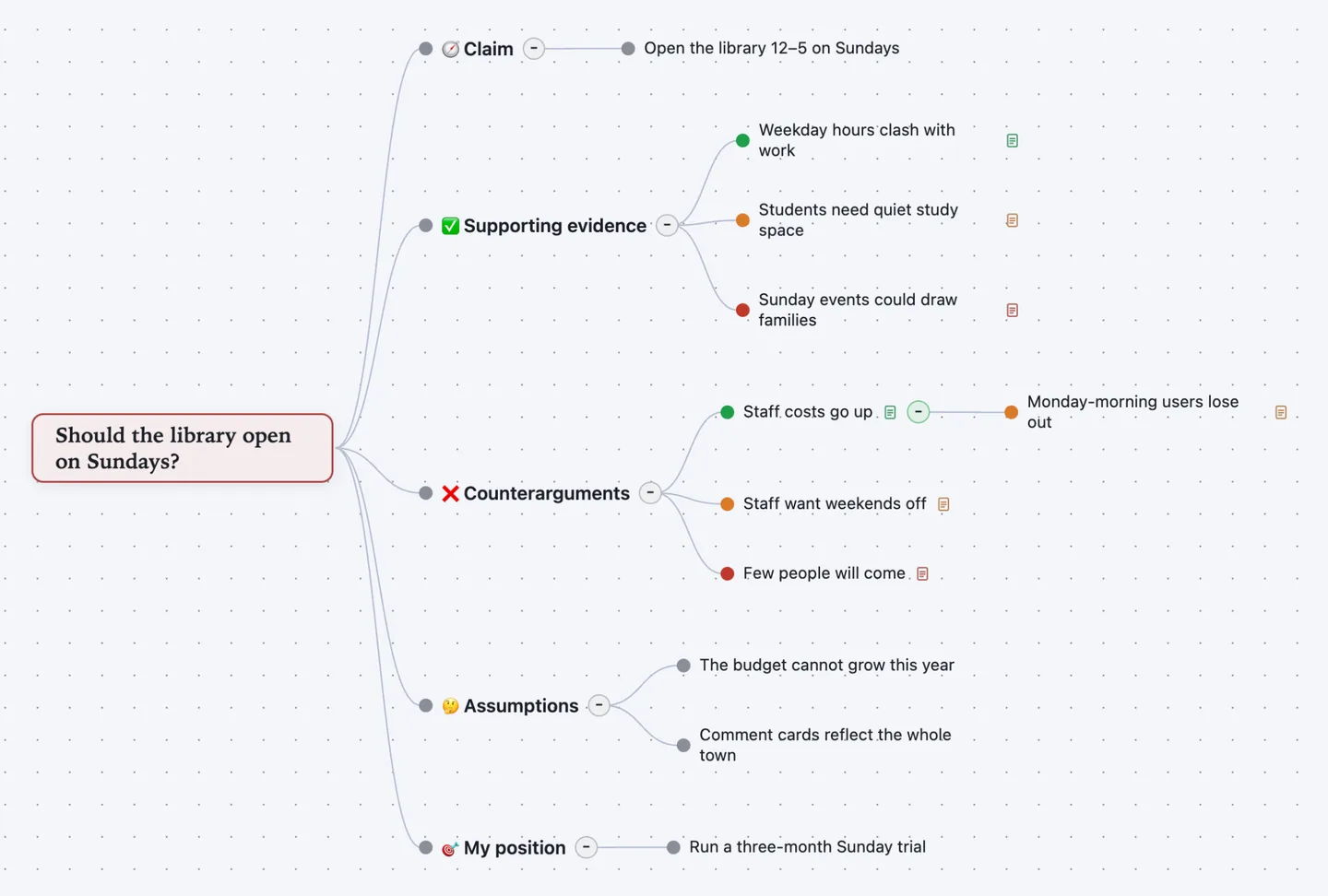
Reasons and objections. Each one is its own branch. An objection to a rebuttal goes one level down, as deep as the debate runs.
Rate every point. Each point has a source, a strength — strong, moderate or weak — and a rebuttal field.
Take a position. End with what you think and why. Export it as a PDF or slides for class or a meeting.
How to make an argument map, step by step
An argument map is a diagram of reasoning. A claim sits at the top. Reasons for it, objections to it and replies to those objections branch below. Argument mapping is taught in critical thinking courses because it shows gaps a paragraph hides.
- Write the claim as one sentence. Make it a statement someone could disagree with. "Open the library on Sundays", not "library hours".
- List the reasons for it. Each reason is a branch. Add its source and rate its strength.
- List the objections. Write the best case against the claim, not the weakest. Each objection gets its own branch.
- Answer each objection. Put the rebuttal in the objection's rebuttal field. If the rebuttal draws a fresh objection, add it one level down.
- Surface the assumptions. What must be true for the reasons to work? Write the unstated premises. They are often the weak spot.
- Weigh it and decide. Look at strengths on both sides. Write your position and the main reason for it.
Worked example: Sunday library hours
A town council debates opening its library on Sundays. The map holds three reasons, three objections with rebuttals, two assumptions and a position. This is the map shown above.
- 🧭 Claim
- Open the library 12–5 on Sundays
- ✅ Supporting evidence
- Weekday hours clash with workSource: Comment cards at the desk · Strength: Strong
- Students need quiet study spaceSource: Letter from the high school · Strength: Moderate
- Sunday events could draw familiesStrength: Weak
- ❌ Counterarguments
- Staff costs go upSource: Library budget · Strength: Strong · Rebuttal: Close Monday mornings instead
- Monday-morning users lose outStrength: Moderate · Rebuttal: Count Monday visits before deciding
- Staff want weekends offStrength: Moderate · Rebuttal: Hire weekend-only staff
- Few people will comeStrength: Weak · Rebuttal: Run a trial and count visits
- Staff costs go upSource: Library budget · Strength: Strong · Rebuttal: Close Monday mornings instead
- 🤔 Assumptions
- The budget cannot grow this year
- Comment cards reflect the whole town
- 🎯 My position
- Run a three-month Sunday trial
Notice the second assumption. The strongest reason rests on comment cards, and only library users fill those in. A trial tests the claim better than more debate.
Let ChatGPT or Claude draft it
Connect Atlas Red to ChatGPT or Claude once. It is free. Then ask:
Make an argument map in Atlas Red for this claim: [claim]. Use the argument map template, give the strongest reasons and objections, add a rebuttal to each objection, rate each point's strength, and list the hidden assumptions.
You get the same template, filled in, in your own account. Fix what it got wrong by hand. Or ask for another round.
Questions people ask
What is an argument map?
A diagram of an argument. The claim sits at the top. Reasons that support it, objections that attack it, and rebuttals to those objections branch below. It makes the structure of reasoning visible, so you can see which points carry weight and which are missing.
Is there a free argument map maker?
Yes. This template is a free argument map maker. It opens in Atlas Red with branches for the claim, supporting evidence, counterarguments, assumptions and your position. Each point has fields for source, strength and rebuttal.
What is the difference between argument mapping and mind mapping?
A mind map collects ideas around a topic with no rules on how they relate. Argument mapping has fixed relations: a point either supports or opposes the one above it. This template uses a mind map's layout with an argument map's rules.
Argument map or Toulmin model: which should I use?
The Toulmin model, from Stephen Toulmin's The Uses of Argument (1958), breaks one argument into claim, grounds, warrant, backing, qualifier and rebuttal. An argument map shows many reasons and objections at once. Use Toulmin to test one reason closely, and the map to see the whole debate. The assumptions branch is where warrants go.
Is this argument map template free?
Yes. It is part of Atlas Red's Free edition. You get up to 10 maps, kept with no end date, every export, and no credit card. Pro is a one-time $99 payment for unlimited maps.
Can I export my argument map to Word or slides?
There is no Word or PowerPoint file. Every edition exports PDF, PNG, JPEG and SVG images, slides, an interactive web page, Markdown, OPML and plain text. Markdown keeps each field as a "Label: value" line, and it pastes into Word or Google Docs. The slides export suits a debate or a class presentation.