Free nursing concept map template
A nursing concept map template
that shows why each step matters.
Put the patient at the centre. Link each cue to a nursing diagnosis, and each diagnosis to its goal, its interventions and the reason for each.
Use it free — no card, no trial →
- Free forever — not a trial
- Up to 10 maps, kept for good
- Every export included
Free has no end date — upgrade only if you outgrow 10 maps. Opens with assessment data, nursing diagnoses, medications, labs, pathophysiology and evaluation already laid out.
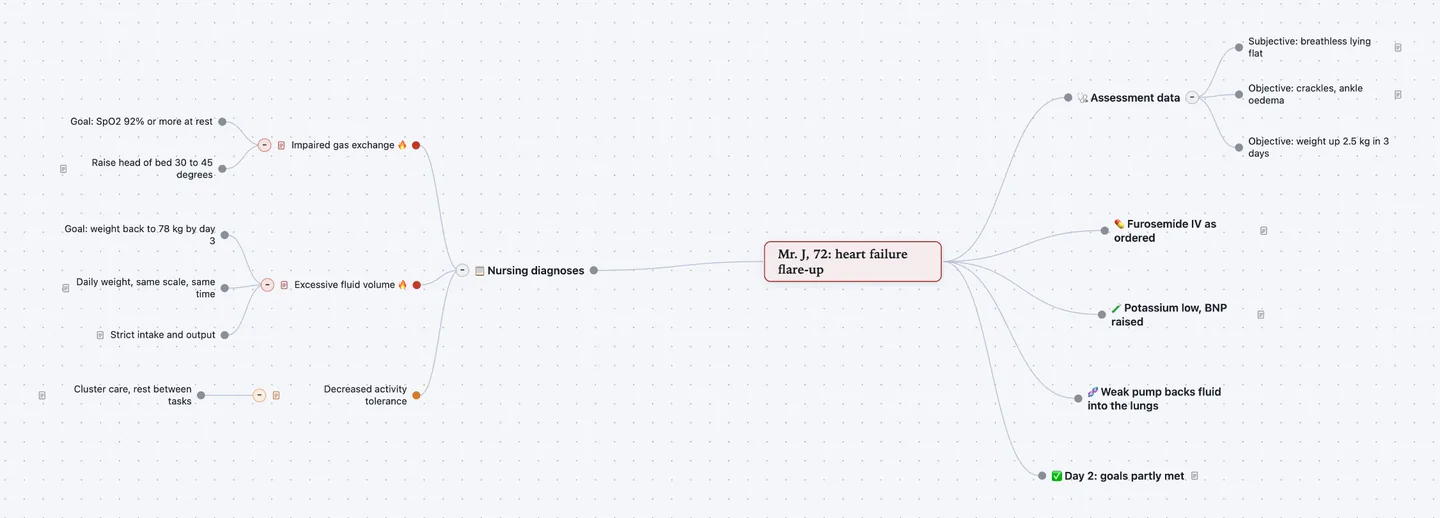
Cues to diagnoses. Subjective and objective data sit in their own branch. Each nursing diagnosis lists the cues that support it.
A reason for every action. Each intervention has a rationale field. Each diagnosis has a priority: high, medium or low.
Hand it in. Export a PDF or an image for the assignment. Or copy the Markdown into Word.
How to make a nursing concept map, step by step
A nursing concept map is a care plan drawn as a diagram. It follows the nursing process: assess, diagnose, plan, implement, evaluate (ADPIE). The map shows how the patient's data leads to each problem and each action. This page is a study aid, not clinical guidance.
- Put the patient at the centre. Write age, reason for admission and the medical diagnosis. Use initials or a made-up name, never real patient details.
- Gather the assessment data. Split it into subjective data (what the patient says) and objective data (what you measure or see). Add labs, medications and the disease process in their own branches.
- Cluster cues into nursing diagnoses. Group the cues that point to one problem. Name it in NANDA-I style: the problem, "related to" its cause, "as evidenced by" the cues.
- Set the priority. Rank the diagnoses. Airway, breathing and circulation come first, then safety, then the rest. Mark each one high, medium or low.
- Write a goal for each diagnosis. Make it about the patient, measurable and timed. "Weight back to 78 kg by day 3", not "fluid improves".
- List interventions with a rationale. Give each action a reason from your textbook or a nursing drug guide. Draw a line from shared data to every diagnosis it supports.
- Evaluate. Check each goal against new data: met, partly met or not met. Then keep, change or stop the plan.
Worked example: heart failure flare-up
Mr. J is a fictional 72-year-old admitted with worsening heart failure. He is short of breath and his ankles are swollen. Three nursing diagnoses hang off his data, each with a goal and interventions. This is the map shown above. It is a study example; real care follows the prescriber's orders and your facility's policy.
- 🩺 Assessment data
- Subjective: breathless lying flatAssessment data: Sleeps on three pillows
- Objective: crackles, ankle oedemaAssessment data: SpO2 89% on room air, 3+ pitting oedema
- Objective: weight up 2.5 kg in 3 days
- 📋 Nursing diagnoses
- Impaired gas exchangePriority: High · Assessment data: SpO2 89%, crackles, breathless lying flat
- Goal: SpO2 92% or more at rest
- Raise head of bed 30 to 45 degreesRationale: Lowers pressure on the diaphragm and eases lung expansion
- Excessive fluid volumePriority: High · Assessment data: Weight gain, oedema, crackles
- Goal: weight back to 78 kg by day 3
- Daily weight, same scale, same timeRationale: 1 kg gained is about 1 litre of retained fluid
- Strict intake and outputRationale: Shows whether the diuretic is working
- Decreased activity tolerancePriority: Medium · Assessment data: Breathless walking to the bathroom
- Cluster care, rest between tasksRationale: Saves energy and lowers oxygen demand
- Impaired gas exchangePriority: High · Assessment data: SpO2 89%, crackles, breathless lying flat
- 💊 Furosemide IV as orderedRationale: Loop diuretic: removes fluid. Watch potassium and blood pressure.
- 🧪 Potassium low, BNP raisedAssessment data: Potassium 3.4 mmol/L · Rationale: Low potassium raises the risk of arrhythmia
- 🧬 Weak pump backs fluid into the lungs
- ✅ Day 2: goals partly metEvaluation: Weight down 1.4 kg, SpO2 93% at rest, still breathless on exertion. Continue plan.
Notice that crackles support two diagnoses. On the map, one cue can link to both, which a care plan table cannot show.
Let ChatGPT or Claude draft it
Connect Atlas Red to ChatGPT or Claude once. It is free. Then ask:
Make a nursing concept map in Atlas Red for this fictional patient: [age, admitting diagnosis, assessment data]. Use the nursing concept map template, write NANDA-I style nursing diagnoses ranked by priority, and give each intervention a rationale.
You get the same template, filled in, in your own account. Fix what it got wrong by hand. Or ask for another round.
Questions people ask
What is a nursing concept map?
A care plan drawn as a diagram. The patient sits at the centre. Branches link assessment data to nursing diagnoses, and each diagnosis to its goals, interventions and evaluation. Nursing schools assign them because the lines show your clinical reasoning, not only your list.
What goes in a nursing concept map template?
Patient basics and the medical diagnosis. Subjective and objective data, labs, medications and pathophysiology. Then prioritised nursing diagnoses, goals, interventions with rationale, and evaluation. This template has a branch for each, plus fields for priority, rationale and evaluation.
Nursing care plan or concept map: what is the difference?
They hold the same content. A nursing care plan is usually a table with columns for diagnosis, goal, intervention, rationale and evaluation. A concept map draws the same plan as a diagram, so you can see which data supports which diagnosis. Many programmes ask for both. Build the map first, then export it as Markdown to fill in the nursing care plan concept map table.
How do I write a nursing diagnosis for a concept map?
Use the NANDA-I format: the problem, "related to" the cause, "as evidenced by" the cues. For example: excessive fluid volume related to weakened heart pumping, as evidenced by weight gain and ankle oedema. Older textbooks say "excess fluid volume" and "activity intolerance". Use the wording your programme asks for.
Is this nursing concept map template free?
Yes. It is part of Atlas Red's Free edition. You get up to 10 maps, kept with no end date, every export, and no credit card. Pro is a one-time $99 payment for unlimited maps.
Can I export my nursing concept map to Word or PDF?
There is no Word or PowerPoint file. Every edition exports PDF, PNG, JPEG and SVG images, slides, an interactive web page, Markdown, OPML and plain text. Markdown keeps each field as a "Label: value" line, and it pastes into Word or Google Docs. Image exports suit an assignment that wants a picture of the map.
Can ChatGPT or Claude make a nursing concept map?
They can draft one. Connect Atlas Red to ChatGPT or Claude and describe a fictional patient. It builds the map from this template in your workspace. Check every diagnosis and rationale against your textbook. Never paste real patient details into any assistant.
Is this template clinical guidance?
No. It is a study aid for nursing students. Real care follows the prescriber's orders, your facility's policy and your instructor's guidance.