Free case brief template
A case brief template
for every case you read.
Facts, issue, rule, holding and reasoning each get a branch. Add pin cites as you read, and the brief is ready for class.
Use it free — no card, no trial →
- Free forever — not a trial
- Up to 10 maps, kept for good
- Every export included
Free has no end date — upgrade only if you outgrow 10 maps. Opens with facts, procedural history, issue, rule, holding, reasoning, concurrence and dissent, and why it matters already laid out.
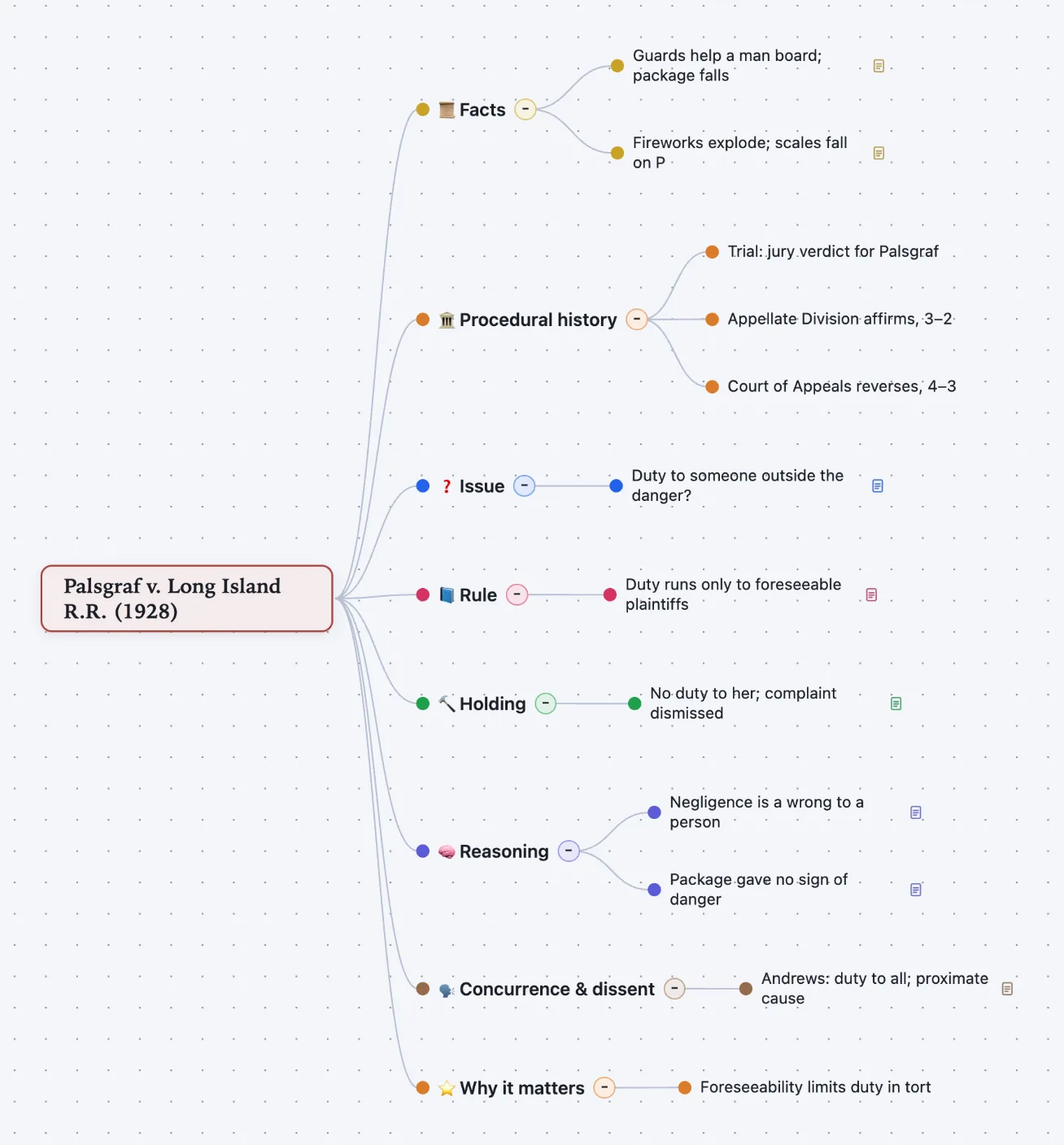
One branch per part. The brief has a fixed shape. You fill it in the same way for every case, so briefs compare at a glance.
Cite as you go. Every point has a pin cite field and an importance mark: high, medium or low.
From brief to outline. Export Markdown and paste it into your course outline. Or print a PDF for cold calls.
How to brief a case, step by step
A case brief is a one-page summary of a court opinion. Law students write one for each assigned case. It forces you to find the question the court answered and the rule it used. IRAC (issue, rule, application, conclusion) is the same logic in exam form.
- Read the opinion twice. Read once for the story. Read again with the brief open, and note page numbers as you go.
- Write the facts that matter. Who did what to whom, and what harm followed. Leave out facts the court did not rely on.
- Trace the procedural history. Who sued whom, what the trial court did, and every appeal. End with how the case reached this court.
- State the issue as a question. One yes-or-no question the court had to answer. Name the legal point and the key facts.
- Write the rule and the holding. The rule is the legal principle the court applied. The holding is its answer to the issue, plus what it did: affirmed, reversed or remanded.
- Summarise the reasoning. Why the court reached its answer. In IRAC terms, this is the application. Note any concurrence or dissent and its main point.
- Say why the case matters. One line on why it is in your casebook. That line goes into your outline.
Worked example: Palsgraf v. Long Island Railroad
Palsgraf v. Long Island Railroad Co., 248 N.Y. 339 (1928), is a first-year torts staple. A package of fireworks exploded on a train platform, and a woman far down the platform was hurt. Chief Judge Cardozo wrote for the New York Court of Appeals. The court held that the railroad owed her no duty. This is the map shown above.
- 📜 Facts
- Guards help a man board; package fallsImportance: High
- Fireworks explode; scales fall on PImportance: High
- 🏛️ Procedural history
- Trial: jury verdict for Palsgraf
- Appellate Division affirms, 3–2
- Court of Appeals reverses, 4–3
- ❓ Issue
- Duty to someone outside the danger?Importance: High
- 📘 Rule
- Duty runs only to foreseeable plaintiffsImportance: High · Pin cite: 248 N.Y. at 344
- 🔨 Holding
- No duty to her; complaint dismissedImportance: High
- 🧠 Reasoning
- Negligence is a wrong to a personImportance: High
- Package gave no sign of dangerImportance: Medium
- 🗣️ Concurrence & dissent
- Andrews: duty to all; proximate causeImportance: Medium
- ⭐ Why it matters
- Foreseeability limits duty in tort
Notice the dissent. Judge Andrews said everyone owes a duty to the world at large. For him the real question was proximate cause: was the harm close enough to the act? Exams test both views, so the dissent stays on the map.
Let ChatGPT or Claude draft it
Connect Atlas Red to ChatGPT or Claude once. It is free. Then ask:
Make a case brief in Atlas Red for [case name and citation]. Use the case brief template: facts, procedural history, issue, rule, holding, reasoning, concurrence and dissent, and why it matters. Add pin cites where you are sure of them.
You get the same template, filled in, in your own account. Fix what it got wrong by hand. Or ask for another round.
Questions people ask
What goes in a case brief template?
The case name and citation, facts, procedural history, issue, rule, holding and reasoning. Add any concurrence or dissent, and a note on why the case matters. Some professors also want the judgment: affirmed, reversed or remanded. This template has a branch for each part.
How do you brief a case for law school?
Read the opinion twice. Write the key facts and the procedural history. State the issue as a yes-or-no question. Then write the rule, the holding and the court's reasoning. Keep it to one page. Briefs are for class and for building your outline.
Case brief or IRAC: what is the difference?
A case brief summarises one court opinion. IRAC (issue, rule, application, conclusion) is a format for answering an exam question. They share parts: the brief's reasoning maps to application, and its holding to the conclusion. Briefing cases is practice for IRAC on the exam.
Is this case brief template free?
Yes. It is part of Atlas Red's Free edition. You get up to 10 maps, kept with no end date, every export, and no credit card. Pro is a one-time $99 payment for unlimited maps.
Can I export my case brief to Word or my outline?
There is no Word or PowerPoint file. Every edition exports PDF, PNG, JPEG and SVG images, slides, an interactive web page, Markdown, OPML and plain text. Markdown keeps each field as a "Label: value" line, and it pastes into Word or Google Docs. That makes it quick to drop each brief into a law school outline.
Can ChatGPT or Claude brief a case for me?
They can draft one. Connect Atlas Red to ChatGPT or Claude and name the case. It builds the brief from this template in your workspace. Check every fact, holding and pin cite against the opinion. Assistants can get citations wrong.
Is the Palsgraf example legal advice?
No. It is a study example of a well-known 1928 New York case. Use it to learn the brief format. Read the full opinion for class.