Free hero's journey template
A hero's journey template
with all 12 stages in place.
The 12 hero's journey stages sit in three parts. For each one, note the scene, how your hero changes and how far it is drafted.
Use it free — no card, no trial →
- Free forever — not a trial
- Up to 10 maps, kept for good
- Every export included
Free has no end date — upgrade only if you outgrow 10 maps. It opens with the 12 stages placed under departure, initiation and return.
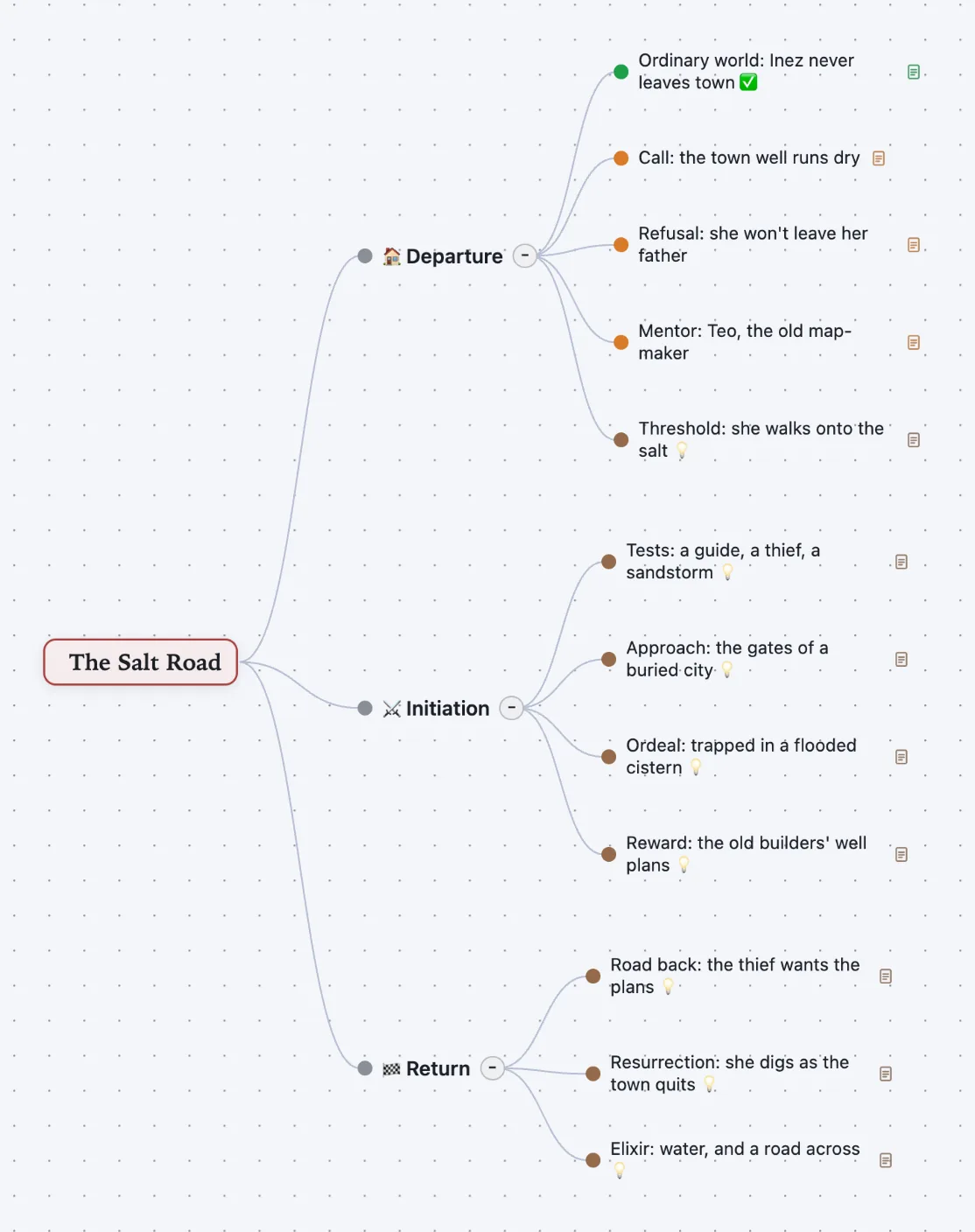
Twelve stages, three parts. Each stage is a branch. Hang scene ideas under it as they come.
Track the inner change. Every stage has a field for how the hero changes. Read them in order to test the arc.
Draft, then reshape. Mark each stage idea, drafted or revised. Drag a scene to another stage. Export the outline as Markdown.
How to plot a story with the hero's journey stages
Joseph Campbell named the monomyth in The Hero with a Thousand Faces (1949). He saw one pattern in myths from many cultures, and described it in 17 stages. Christopher Vogler, a story consultant in Hollywood, cut it to 12 stages for writers. His book is The Writer's Journey. This template follows his 12, grouped in Campbell's three parts.
- Start in the ordinary world. Show the hero's normal life and what is missing from it. The reader needs this to see the change later.
- Send the call, then the refusal. Something invites the hero out of that life. The hero hesitates. Fear or duty holds them back. The refusal shows what is at stake.
- Bring in the mentor. Someone gives the hero advice, a tool or the nerve to go. The mentor can be a person, a memory or a book.
- Cross the threshold. The hero commits and enters a new world. There is no easy way back. The first act ends here.
- Test the hero, then stage the ordeal. In the new world the hero meets allies and enemies and learns the rules. Then they near the place of greatest danger. The ordeal is the crisis: a brush with death, real or inner.
- Pay the reward, then the price. The hero takes the prize. On the road back, the danger follows. In the resurrection the hero faces one last test and proves the change.
- Bring the elixir home. The hero returns with something that heals the ordinary world. It can be an object, a cure or a lesson.
Worked example: The Salt Road
An original story. Inez bakes bread in a desert town called Dry Wells. She has never crossed the salt flats beyond it. Then the town well runs dry. Here are her 12 stages under departure, initiation and return. This is the map shown above.
- 🏠 Departure
- Ordinary world: Inez never leaves townScene: The bakery at dawn · Character change: Safe, small, afraid of the desert · Status: Revised
- Call: the town well runs dryScene: Empty buckets in the square · Status: Drafted
- Refusal: she won't leave her fatherScene: Her father's sickbed · Character change: Uses duty as an excuse · Status: Drafted
- Mentor: Teo, the old map-makerScene: Teo gives her his last map · Status: Drafted
- Threshold: she walks onto the saltScene: Edge of the flats, at night · Character change: Chooses to go · Status: Idea
- ⚔️ Initiation
- Tests: a guide, a thief, a sandstormStatus: Idea
- Approach: the gates of a buried cityStatus: Idea
- Ordeal: trapped in a flooded cisternScene: The map is lost in the water · Character change: Trusts herself, not the map · Status: Idea
- Reward: the old builders' well plansStatus: Idea
- 🏁 Return
- Road back: the thief wants the plansStatus: Idea
- Resurrection: she digs as the town quitsCharacter change: Leads instead of waiting · Status: Idea
- Elixir: water, and a road acrossCharacter change: Opens the desert to others · Status: Idea
Read the character change fields in order. Afraid, then committed, then trusting herself, then leading. If your fields do not climb like that, your hero only travels. They do not change.
Let ChatGPT or Claude draft it
Connect Atlas Red to ChatGPT or Claude once. It is free. Then ask:
Make a hero's journey map in Atlas Red for my story: [hero, what they want, what stands in the way]. Use the hero's journey template. Fill all 12 stages with a scene and how the hero changes.
You get the same template, filled in, in your own account. Fix what it got wrong by hand. Or ask for another round.
Questions people ask
What are the 12 stages of the hero's journey?
These are Christopher Vogler's 12, from The Writer's Journey. Departure: ordinary world, call to adventure, refusal of the call, meeting the mentor, crossing the threshold. Initiation: tests, allies and enemies, approach to the inmost cave, the ordeal, reward. Return: the road back, resurrection, return with the elixir.
Did Campbell have 12 stages or 17?
Campbell named 17 stages in The Hero with a Thousand Faces (1949). Vogler wrote for screenwriters and cut them to 12. He kept the shape, merged some stages and dropped others. Most writing guides use Vogler's 12. So does this template.
Hero's journey or Save the Cat: which should I use?
They answer different questions. Save the Cat is a plot plan: 15 beats pinned to pages of a script. The hero's journey tracks the hero's inner path in 12 stages. Many writers plot with Save the Cat and test the inner arc against the hero's journey. Crossing the threshold lines up with break into two.
Does every story need all 12 stages?
No. The stages are a checklist, not a law. Some stories skip the refusal. Some bring the mentor in late, or make the hero their own mentor. Use the stages to find what is missing. Then decide if the story needs it.
Is this hero's journey template free?
Yes. It is part of Atlas Red's Free edition. You get up to 10 maps, kept with no end date, every export, and no credit card. Pro is a one-time $99 payment for unlimited maps.
Can I export a hero's journey template to Word or Scrivener?
There is no Word file. Every edition exports PDF, PNG, JPEG and SVG images, slides, an interactive web page, Markdown, OPML and plain text. Markdown keeps each field as a "Label: value" line and pastes into Word or Google Docs. OPML opens in many outliners, Scrivener among them.