Free Save the Cat beat sheet template
A Save the Cat beat sheet template
with room for every scene.
All 15 beats sit under their act. Note the page target, how your hero changes and how far each beat is drafted.
Use it free — no card, no trial →
- Free forever — not a trial
- Up to 10 maps, kept for good
- Every export included
Free has no end date — upgrade only if you outgrow 10 maps. Opens with the 15 beats already placed under Act 1, Act 2 and Act 3.
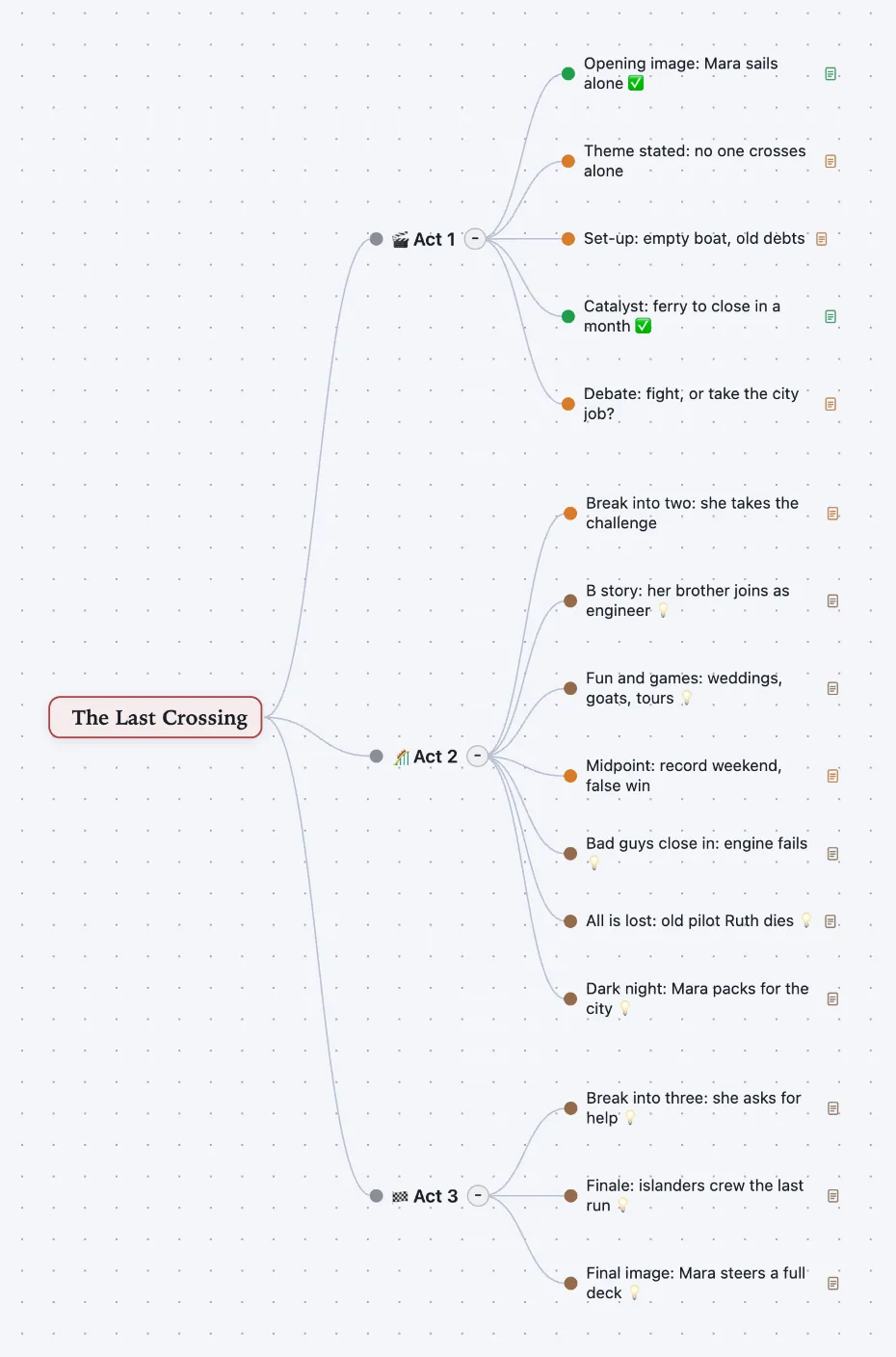
Fifteen beats, three acts. Each beat is a branch. Hang scenes and ideas under it as they come.
Track the change. Every beat has fields for its page target, how the hero changes and its status: idea, drafted or revised.
Move beats around. Drag a scene to another beat. Export the outline as Markdown and start writing.
How to fill in a Save the Cat beat sheet
Save the Cat! is a screenwriting book by Blake Snyder, published in 2005. Its beat sheet splits a story into 15 beats. Snyder pinned each beat to a page of a 110-page script. Page targets are a guide, not a law.
- Write the logline first. One sentence: who the hero is, what they want and what stands in the way. Put it at the centre of the map.
- Fix the opening and final images. They bookend the story. The final image shows the opposite of the first, so the change is visible.
- Find the catalyst and the break into two. The catalyst is the event that upsets the hero's life. Break into two is the choice to step into a new world. That choice must be the hero's own.
- Place the midpoint. Halfway through, the hero wins or loses big, and the stakes go up. A false win or a false defeat both work.
- Build to all is lost. Pressure grows from outside and inside. Then the hero hits bottom. Snyder suggests a hint of death here: a person, a hope or an old self.
- Write the finale. The hero mixes what they learned in the A story and the B story. They solve the problem in a way they could not at the start.
- Hang scenes under each beat. Add scene ideas as children. Mark each beat idea, drafted or revised as you write.
Worked example: The Last Crossing
An original story. Mara is a ferry captain on a small island. She works alone and trusts no one. The council will shut the ferry unless it fills enough seats in one month. Here are her 15 beats, with page targets for a 110-page script. This is the map shown above.
- 🎬 Act 1
- Opening image: Mara sails alonePage: 1 · Status: Revised · Character change: Closed off, self-reliant
- Theme stated: no one crosses alonePage: 5 · Status: Drafted
- Set-up: empty boat, old debtsPage: 1–10 · Status: Drafted
- Catalyst: ferry to close in a monthPage: 12 · Status: Revised
- Debate: fight, or take the city job?Page: 12–25 · Status: Drafted
- 🎢 Act 2
- Break into two: she takes the challengePage: 25 · Status: Drafted · Character change: Chooses to fight
- B story: her brother joins as engineerPage: 30 · Status: Idea
- Fun and games: weddings, goats, toursPage: 30–55 · Status: Idea
- Midpoint: record weekend, false winPage: 55 · Status: Drafted
- Bad guys close in: engine failsPage: 55–75 · Status: Idea · Character change: Pushes her brother away
- All is lost: old pilot Ruth diesPage: 75 · Status: Idea
- Dark night: Mara packs for the cityPage: 75–85 · Status: Idea
- 🏁 Act 3
- Break into three: she asks for helpPage: 85 · Status: Idea · Character change: Lets others in
- Finale: islanders crew the last runPage: 85–110 · Status: Idea
- Final image: Mara steers a full deckPage: 110 · Status: Idea · Character change: Leads a crew
Read the opening and final images side by side. Alone on an empty boat, then at the wheel of a full one. If your two images do not differ like that, the middle needs work.
Let ChatGPT or Claude draft it
Connect Atlas Red to ChatGPT or Claude once. It is free. Then ask:
Make a Save the Cat beat sheet in Atlas Red for my story: [logline]. Use the Save the Cat beat sheet template, fill all 15 beats with page targets for a 110-page script, and note how the hero changes.
You get the same template, filled in, in your own account. Fix what it got wrong by hand. Or ask for another round.
Questions people ask
What are the 15 beats of Save the Cat?
Blake Snyder set them out in Save the Cat! (2005). Act 1: opening image, theme stated, set-up, catalyst, debate. Act 2: break into two, B story, fun and games, midpoint, bad guys close in, all is lost, dark night of the soul. Act 3: break into three, finale, final image.
What page does each beat land on in a 110-page script?
These are Snyder's targets. Act 1: opening image 1, theme stated 5, set-up 1–10, catalyst 12, debate 12–25. Act 2: break into two 25, B story 30, fun and games 30–55, midpoint 55, bad guys close in 55–75. Then all is lost 75 and dark night of the soul 75–85. Act 3: break into three 85, finale 85–110, final image 110. Scale them for a shorter or longer script.
Does a Save the Cat beat sheet template work for novels?
Yes. Use percentages instead of pages: the catalyst near 10%, the midpoint at 50%, all is lost near 75%. Jessica Brody adapted the method for fiction in Save the Cat! Writes a Novel (2018). Change the Page field to a percent or a chapter.
Save the Cat, three-act structure or hero's journey: which should I use?
Save the Cat is a three-act structure with more stops. It names 15 beats where three acts name three blocks. The hero's journey, from Joseph Campbell, tracks a hero's inner path in stages. Many writers draft with Save the Cat and check the inner arc against the hero's journey.
Is this Save the Cat beat sheet template free?
Yes. It is part of Atlas Red's Free edition. You get up to 10 maps, kept with no end date, every export, and no credit card. Pro is a one-time $99 payment for unlimited maps.
Can I export my beat sheet to Word or a screenwriting app?
There is no Word or PowerPoint file. Every edition exports PDF, PNG, JPEG and SVG images, slides, an interactive web page, Markdown, OPML and plain text. Markdown keeps each field as a "Label: value" line, and it pastes into Word or Google Docs. OPML opens in many outliners. You can also export a PDF to share with a writing group.