Free course outline template
A course outline template
that shows the whole course at once.
Write what learners will be able to do. Split the course into modules and lessons. Give each lesson an objective, a length and a format.
Use it free — no card, no trial →
- Free forever — not a trial
- Up to 10 maps, kept for good
- Every export included
Free has no end date — upgrade only if you outgrow 10 maps. It opens with learning outcomes, three modules of two lessons, an assessment and resources.
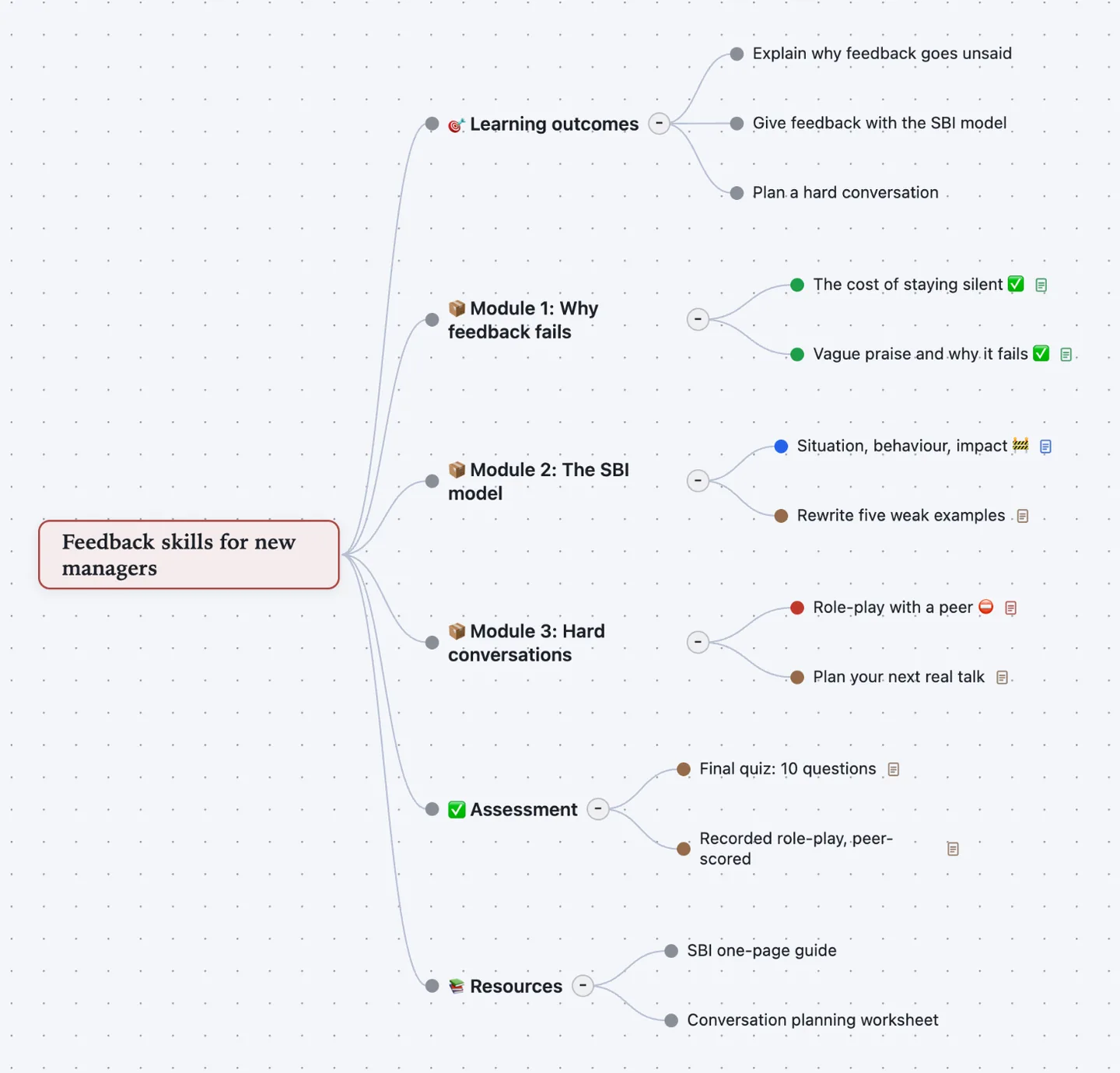
Outcomes first. Start from what learners can do at the end. Every lesson must serve one.
Every lesson planned. Each lesson has an objective, a duration in minutes, a format and a status.
Move lessons around. Drag a lesson to another module. Export the outline as a PDF, slides or Markdown.
How to write a course outline, step by step
A course outline is the plan of a course. It names what learners will be able to do, and the lessons that get them there. Course creators, trainers and teachers all use one. Most work backwards: outcomes first, content last.
- Name the learner. Write who the course is for and what they know already. A course for new managers starts in a different place than one for HR.
- Write the learning outcomes. An outcome is what a learner can do by the end. Start it with a verb you can observe: name, explain, use, compare, judge, design. Avoid "understand". You can't see it.
- Pitch them with Bloom's taxonomy. Bloom's taxonomy ranks thinking in six levels: remember, understand, apply, analyze, evaluate, create. A short course often stops at apply. Pick verbs from the level you aim for.
- Group the content into modules. A module is a block of lessons with one theme. Three to six modules suit most short courses.
- Plan each lesson. Give each lesson one learning objective. Set its length in minutes and its format: video, reading, exercise, live session or quiz.
- Plan the assessment. Check every outcome at least once. A quiz checks what learners remember. A task or role-play checks what they can do.
- Track the build. Mark each lesson not started, in progress, blocked or done. The map shows what is left to make.
Worked example: feedback skills for new managers
A trainer builds a short online course for first-time managers. It has three modules, a live role-play and a final quiz. Each lesson carries its objective, length and format. This is the map shown above.
- 🎯 Learning outcomes
- Explain why feedback goes unsaid
- Give feedback with the SBI model
- Plan a hard conversation
- 📦 Module 1: Why feedback fails
- The cost of staying silentLearning objective: Describe what silence costs a team · Duration (min): 8 · Format: Video · Status: Done
- Vague praise and why it failsLearning objective: Tell vague from specific praise · Duration (min): 10 · Format: Reading · Status: Done
- 📦 Module 2: The SBI model
- Situation, behaviour, impactLearning objective: Name the three parts of SBI · Duration (min): 12 · Format: Video · Status: In progress
- Rewrite five weak examplesLearning objective: Rewrite vague feedback in SBI form · Duration (min): 20 · Format: Exercise · Status: Not started
- 📦 Module 3: Hard conversations
- Role-play with a peerLearning objective: Deliver SBI feedback face to face · Duration (min): 45 · Format: Live session · Status: Blocked
- Plan your next real talkLearning objective: Plan a real conversation with SBI · Duration (min): 15 · Format: Exercise · Status: Not started
- ✅ Assessment
- Final quiz: 10 questionsDuration (min): 15 · Format: Quiz · Status: Not started
- Recorded role-play, peer-scoredDuration (min): 30 · Format: Exercise · Status: Not started
- 📚 Resources
- SBI one-page guide
- Conversation planning worksheet
Read the objectives top to bottom. Module 1 asks learners to describe. Modules 2 and 3 ask them to rewrite, deliver and plan. That is Bloom's apply level, the right aim for a short skills course. The role-play is blocked until a facilitator is booked.
Let ChatGPT or Claude draft it
Connect Atlas Red to ChatGPT or Claude once. It is free. Then ask:
Make a course outline in Atlas Red for a course on [topic] for [learners]. Use the course outline template. Write three learning outcomes, then modules and lessons, each with a learning objective, duration in minutes and format.
You get the same template, filled in, in your own account. Fix what it got wrong by hand. Or ask for another round.
Questions people ask
What goes in a course outline template?
The learning outcomes, the modules and the lessons inside them. Each lesson has an objective, a length and a format. Then the assessment and the resources. A course outline for a school adds the schedule and grading.
How do I write learning objectives?
Name what the learner will do, with a verb you can observe. "Rewrite vague feedback in SBI form" works. "Understand feedback" does not. Add the conditions and the standard when they matter. One objective per lesson keeps each lesson focused.
How does Bloom's taxonomy help with objectives?
Benjamin Bloom and colleagues published the taxonomy in 1956. Lorin Anderson and David Krathwohl revised it in 2001. The revised levels are remember, understand, apply, analyze, evaluate and create. Each level has its own verbs. Use them to check that your objectives match the course's aim.
Course outline or syllabus template: what is the difference?
A course outline is the designer's plan: outcomes, modules, lessons. A syllabus is the document learners get. It adds dates, grading, contact details and policies. Plan in the outline first. Then export Markdown and paste it into your syllabus template in Word or Google Docs.
Does it work as a training plan template?
Yes. Rename modules to sessions or weeks. Use the Format field for workshops, e-learning or on-the-job tasks. The Status field tracks what is built or delivered. Add a branch per team if the plan covers several.
Is this course outline template free?
Yes. It comes with Atlas Red's Free edition. You get up to 10 maps, kept with no end date, and every export. No credit card. Pro is one payment of $99 for unlimited maps.
Can I export my course outline to Word or PowerPoint?
There is no Word or PowerPoint file. Every edition exports PDF, PNG, JPEG, SVG, slides, an interactive web page, Markdown, OPML and plain text. Markdown pastes into Word or Google Docs, with fields as "Label: value" lines. The slides export works for a kickoff talk.