Free GROW model coaching template
A GROW model template
that keeps the coachee's words.
Goal, reality, options, will. Write down what the coachee says under each, and the question you ask next.
Use it free — no card, no trial →
- Free forever — not a trial
- Up to 10 maps, kept for good
- Every export included
Free has no end date — upgrade only if you outgrow 10 maps. Opens with goal, reality, options and will branches, and two starter coaching questions under each.
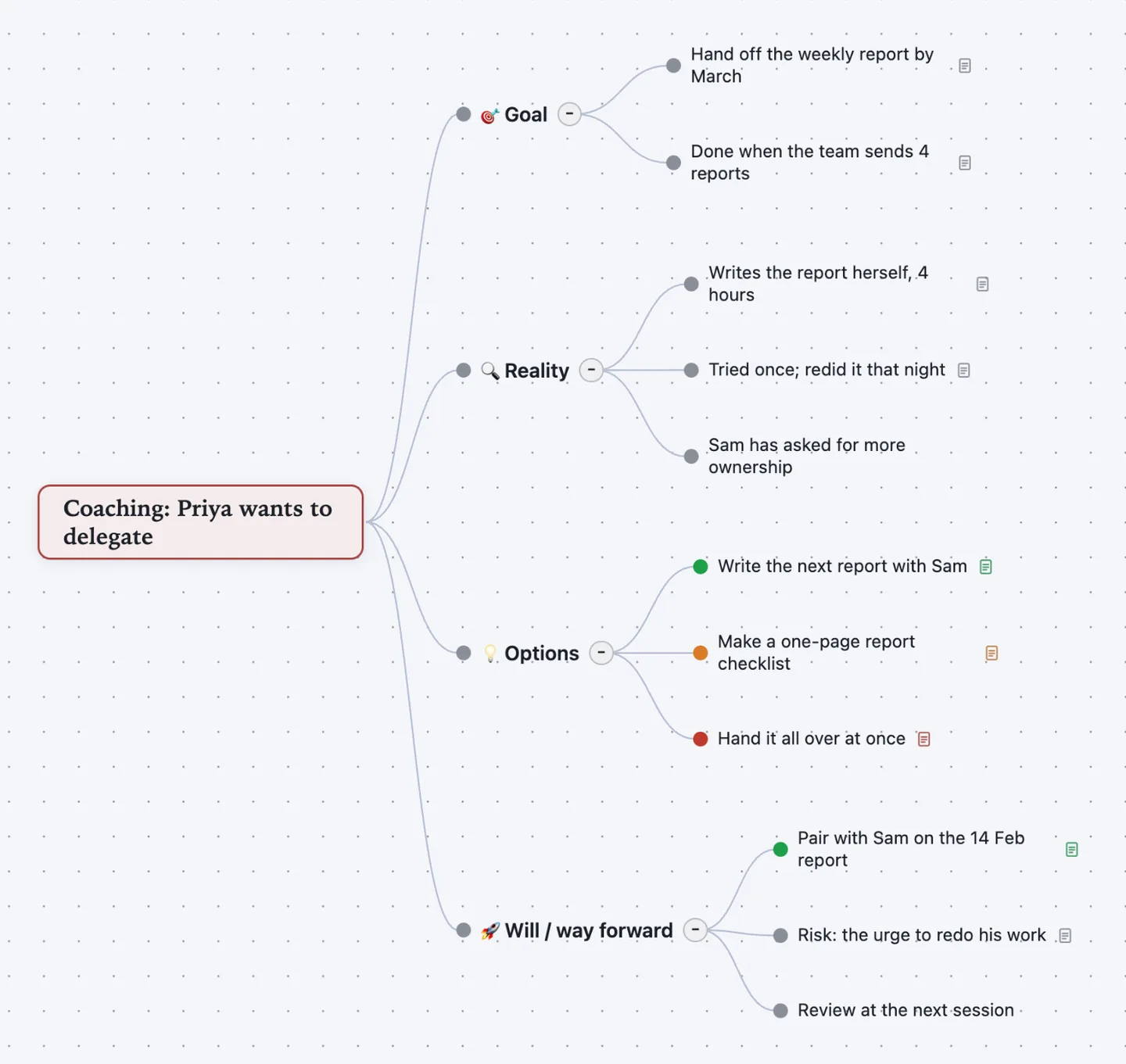
Four stages, in order. Each GROW stage is a branch with starter questions. Add a topic each time the coachee says something worth keeping.
Their words, your question. Every topic has a field for the coachee's words and one for the question you ask next. You listen; the map holds the notes.
End with a commitment. Rate each action high, medium or low commitment. Open the same map at the next session and check what happened.
How to run a GROW coaching session, step by step
The GROW model came out of 1980s business coaching. Graham Alexander, Alan Fine and Sir John Whitmore are credited with it. Whitmore made it known in his book Coaching for Performance. GROW stands for Goal, Reality, Options and Will — sometimes Way forward. The coach asks; the coachee finds the answers.
- Goal: agree what this session is for. Ask what they want to achieve and how they will know they got there. Make it specific. "Delegate more" becomes "hand off the weekly report by March".
- Reality: find out what is true now. Ask what is happening and what they have tried. Write their words, not your summary. Stay here until the picture is clear.
- Options: list what they could do. Ask "what could you do?", then "what else?". Don't judge yet. The third or fourth option is often the best.
- Will: commit to a next step. Ask what they will do, and by when. Ask what might get in the way. Rate how committed they sound.
- Go back when you need to. GROW is not a straight line. If reality shows the goal is wrong, return to the goal. That is the model working.
- Check in next time. Open the map at the next session. Ask what they did and what they learned. That is the reality for the new goal.
Worked example: a team lead who wants to delegate
Priya leads a team of five and works 50-hour weeks. She asks her coach for help handing work off. This is the map shown above.
- 🎯 Goal
- Hand off the weekly report by MarchCoachee's words: I want my Fridays back. · Question to ask: What would that free you to do?
- Done when the team sends 4 reportsQuestion to ask: Who would notice first?
- 🔍 Reality
- Writes the report herself, 4 hoursCoachee's words: It's faster if I just do it.
- Tried once; redid it that nightQuestion to ask: What was wrong with his version?
- Sam has asked for more ownership
- 💡 Options
- Write the next report with SamCommitment: High
- Make a one-page report checklistCommitment: Medium
- Hand it all over at onceCoachee's words: Too much, too soon. · Commitment: Low
- 🚀 Will / way forward
- Pair with Sam on the 14 Feb reportCoachee's words: I'll book it today. · Commitment: High
- Risk: the urge to redo his workQuestion to ask: What will you do when you feel it?
- Review at the next session
Notice the low-commitment option. It stays on the map, so the coach can ask about it later. The way forward came from Priya, not the coach.
Let ChatGPT or Claude draft it
Connect Atlas Red to ChatGPT or Claude once. It is free. Then ask:
Make a GROW coaching map in Atlas Red for this session: [the coachee's goal and my notes, no names or private details]. Use the GROW model template, put their words under the right stage, and suggest one open question for each stage.
You get the same template, filled in, in your own account. Fix what it got wrong by hand. Or ask for another round.
Questions people ask
What is the GROW model of coaching?
A four-stage structure for a coaching conversation: Goal, Reality, Options, Will. The coach asks open questions. The coachee does the thinking and chooses the action. Graham Alexander, Alan Fine and Sir John Whitmore developed it in the 1980s.
What are good GROW coaching questions?
Goal: "What do you want to achieve?" and "How will you know?". Reality: "What is happening now?" and "What have you tried?". Options: "What could you do?" and "What else?". Will: "What will you do, and by when?" and "What might get in the way?". The template opens with these as starter topics.
Is this GROW model coaching template free?
Yes. It is part of Atlas Red's Free edition: up to 10 maps, kept with no end date, every export included, no credit card. Pro is a one-time $99 payment for unlimited maps.
Is it safe to keep coaching notes in Atlas Red?
Your maps stay in your own account. Nobody else sees one unless you create a share link. Coaching notes can be personal, so keep only what you need. Use first names or initials, and follow any rules your organisation sets for client records.
Can I export a GROW session to Word or PowerPoint?
There is no Word or PowerPoint export. Every edition exports PDF, PNG, JPEG and SVG images, slides, an interactive web page, Markdown, OPML and plain text. Markdown keeps your fields as "Label: value" lines and pastes into Word or Google Docs.
Can ChatGPT or Claude help me prepare a GROW session?
Yes. Connect Atlas Red to ChatGPT or Claude. Describe the goal and ask for a GROW map with questions for each stage. It builds the map from this template in your workspace. Leave out names and private details.
GROW model vs other coaching models — which should I use?
GROW suits a single conversation that should end in an action. Models such as OSKAR or CLEAR add stages for reviewing progress or contracting the relationship. Many coaches start with GROW and adapt it. Rename the branches if your model differs.