Free ADKAR change management plan template
An ADKAR change plan
for every group it touches.
The five ADKAR stages are the branches. Under each, plan what every group needs, who does it and how ready they are.
Use it free — no card, no trial →
- Free forever — not a trial
- Up to 10 maps, kept for good
- Every export included
Free has no end date — upgrade only if you outgrow 10 maps. It opens with the five stages laid out: awareness, desire, knowledge, ability and reinforcement.
Five stages, in order. Each stage is a branch. People pass through them one at a time.
A plan per group. Two teams resist for different reasons. Give each its own actions.
See who is behind. Each action has an owner and a readiness: high, medium or low. Low shows where to act first.
How to build an ADKAR change management plan
ADKAR is a model of how one person goes through a change. Jeff Hiatt, who founded Prosci, set it out in the late 1990s. The letters stand for awareness, desire, knowledge, ability and reinforcement. A change works when enough people pass all five. The order matters. Training does little for someone who sees no reason to change.
- Name the change and its date. Write what changes, for whom and when. "Support moves to the new help desk on 1 March" is a change. "Better service" is a hope.
- List the groups it touches. Split people by how the change hits them. A team that loses a tool needs a different plan from a team that gains a task.
- Awareness: explain why. Say what is wrong today and what happens if nothing changes. Let the sponsor say it. The sponsor is the leader who owns the change.
- Desire: answer "what's in it for me?". Knowing why is not wanting to. Find each group's reasons to resist. Let their own manager hold that talk.
- Knowledge and ability: train, then practise. Knowledge is knowing how. Ability is doing it on the job. Plan the training, then time to practise with help close by.
- Reinforcement: make it stick. Thank the people who use the new way. Measure use. Switch off the old way, so nobody drifts back.
- Rate readiness and work the gaps. Rate each group at each stage: high, medium or low. The first low stage is where the change stalls. Work there first.
Worked example: a new help desk at Northfield
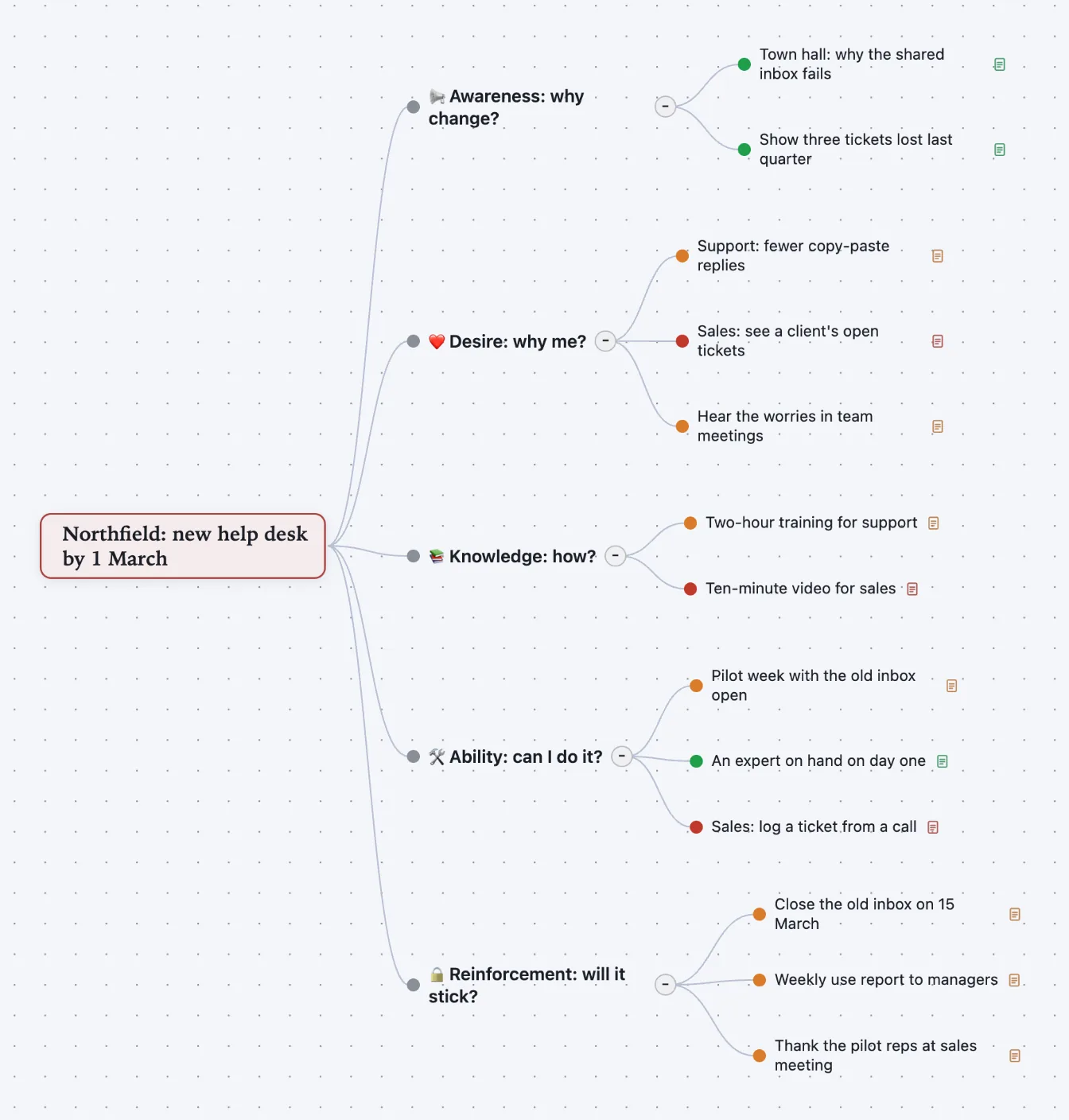
Northfield is a made-up company of 60 people. Support answers clients from a shared email inbox, and tickets get lost. On 1 March support moves to a help desk tool. Sales must use it too, to log client problems. Here is the plan for both teams. This is the map shown above.
- 📢 Awareness: why change?
- Town hall: why the shared inbox failsGroup affected: Support and sales · Owner: Priya, COO · Readiness: High
- Show three tickets lost last quarterGroup affected: Support · Owner: Priya, COO · Readiness: High
- ❤️ Desire: why me?
- Support: fewer copy-paste repliesGroup affected: Support · Owner: Leo, support lead · Readiness: Medium
- Sales: see a client's open ticketsGroup affected: Sales · Action: Two reps pilot it and report back · Owner: Ana, sales lead · Readiness: Low
- Hear the worries in team meetingsGroup affected: Support and sales · Owner: Leo and Ana · Readiness: Medium
- 📚 Knowledge: how?
- Two-hour training for supportGroup affected: Support · Owner: Vendor trainer · Readiness: Medium
- Ten-minute video for salesGroup affected: Sales · Owner: Ana, sales lead · Readiness: Low
- 🛠️ Ability: can I do it?
- Pilot week with the old inbox openGroup affected: Support · Owner: Leo, support lead · Readiness: Medium
- An expert on hand on day oneGroup affected: Support · Owner: Sam, IT · Readiness: High
- Sales: log a ticket from a callGroup affected: Sales · Action: Practise on three real calls · Owner: Ana, sales lead · Readiness: Low
- 🔒 Reinforcement: will it stick?
- Close the old inbox on 15 MarchGroup affected: Support · Owner: Sam, IT · Readiness: Medium
- Weekly use report to managersGroup affected: Support and sales · Owner: Priya, COO · Readiness: Medium
- Thank the pilot reps at sales meetingGroup affected: Sales · Owner: Ana, sales lead · Readiness: Medium
Read down the readiness fields. Sales is low from desire onward. More training will not fix that. So the plan starts with two reps who pilot the tool and tell the others why it helps.
Let ChatGPT or Claude draft it
Connect Atlas Red to ChatGPT or Claude once. It is free. Then ask:
Make an ADKAR change plan in Atlas Red for this change: [what changes, for whom, by when]. Use the ADKAR change plan template. Add actions for each group under all five stages, with an owner and a readiness rating.
You get the same template, filled in, in your own account. Fix what it got wrong by hand. Or ask for another round.
Questions people ask
What is the ADKAR model?
ADKAR is a model of how one person goes through a change. Jeff Hiatt, who founded Prosci, set it out in the late 1990s. The five letters are awareness, desire, knowledge, ability and reinforcement. Its core idea: an organisation changes only when its people do, one at a time.
What goes in an ADKAR change management plan template?
The change, the groups it touches and the five stages. Under each stage, list actions for each group. Give every action an owner and a readiness rating. This template has a field for each: group affected, action, owner and readiness.
How do you measure readiness in ADKAR?
Ask people, or their managers, to rate each stage for a group. Prosci's own assessment uses a score from 1 to 5. This template keeps it to high, medium and low. The first stage that scores low is the barrier point. Work there before you move on.
ADKAR or Kotter's 8 steps: which should I use?
They look at a change from two sides. Kotter's 8 steps, from John Kotter's book Leading Change (1996), say what leaders do. ADKAR says what each person goes through. Many teams use both. Kotter shapes the leadership plan. ADKAR checks that each group keeps up.
Is this ADKAR change management plan template free?
Yes. It comes with Atlas Red's Free edition. You get up to 10 maps, kept with no end date, and every export. No credit card. Pro is one payment of $99 for unlimited maps.
Can I export the change plan to Word, Excel or PowerPoint?
Not as those files. Every edition exports PDF, PNG, JPEG, SVG, slides, an interactive web page, Markdown, OPML and plain text. Export Markdown and paste it into Word or Google Docs. Each field comes along as a "Label: value" line. Use the slides export for the steering meeting.