Free 30 60 90 day plan template
A 30 60 90 day plan template
you will open again on day 45.
Three branches — learn, contribute, lead — and one for how you will be judged. Each goal has a status and a date, so the plan tracks itself.
Use it free — no card, no trial →
- Free forever — not a trial
- Up to 10 maps, kept for good
- Every export included
Free has no end date — upgrade only if you outgrow 10 maps. Opens with learn, contribute and lead branches, starter goals under each, and a branch for how success is measured.
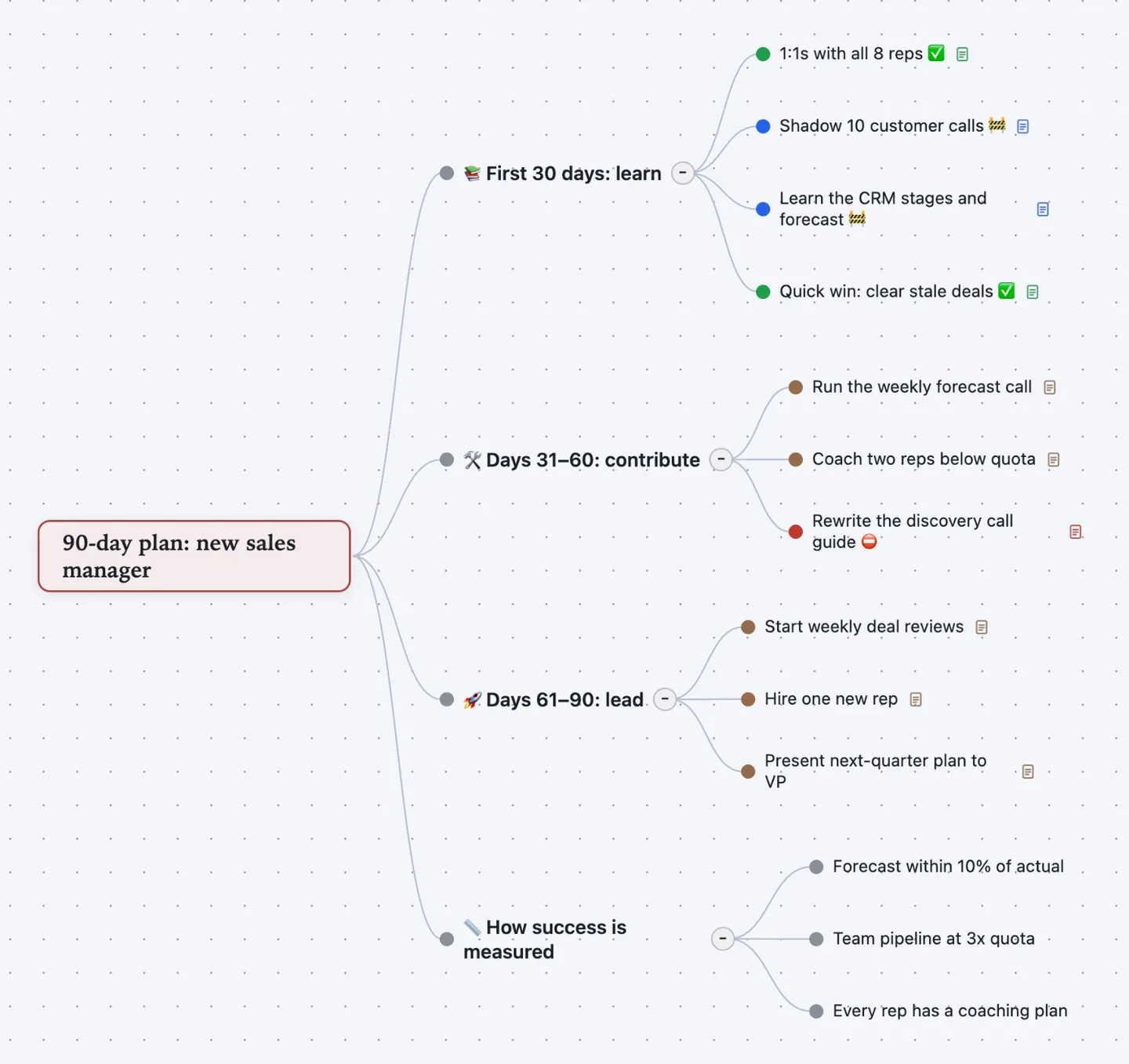
Three phases, one page. Days 1–30 to learn, 31–60 to contribute, 61–90 to lead. Each phase holds as many goals as it needs.
Track it as you go. Every goal has a status, a due date and a success measure. The map colours itself by status, so you see what is stuck.
Show it in the interview. Export the plan as a PDF or slides for a hiring panel. Bring the same map to your 30-day check-in.
How to write a 30 60 90 day plan, step by step
A 30-60-90 day plan sets out what you will do in your first three months in a role. The usual shape: learn in the first 30 days, contribute by day 60, lead by day 90. Candidates bring one to interviews. Managers write one with each new hire.
- Start with how you will be judged. Ask your manager what a good first 90 days looks like. Write two or three measures you can check. Everything else serves them.
- Days 1–30: learn. List the people to meet and the things to learn: product, customers, tools, numbers. Pick one quick win you can deliver in the first month.
- Days 31–60: contribute. Take ownership of real work. Name the projects you will own and one process you will improve.
- Days 61–90: lead. Start something of your own. Name the initiative and the results you will show at day 90.
- Give each goal a date and a measure. "Meet the team" becomes "1:1s with all 8 reps by day 10". A goal without a date is a wish.
- Review it every two weeks. Update each status. Move or drop goals that no longer fit. Take the map to your 30, 60 and 90-day check-ins.
Worked example: a new sales manager
A sales manager takes over a team of eight reps at a software company. The plan sits at the centre; each phase is a branch. This is the map shown above.
- 📚 First 30 days: learn
- 1:1s with all 8 repsStatus: Done · Due date: Day 10 · Success measure: Notes on each rep's pipeline
- Shadow 10 customer callsStatus: In progress · Due date: Day 25
- Learn the CRM stages and forecastStatus: In progress · Due date: Day 20
- Quick win: clear stale dealsStatus: Done · Due date: Day 30 · Success measure: No deal untouched for 60 days
- 🛠️ Days 31–60: contribute
- Run the weekly forecast callStatus: Not started · Due date: Day 35
- Coach two reps below quotaStatus: Not started · Due date: Day 60 · Success measure: Both at 80% of quota
- Rewrite the discovery call guideStatus: Blocked · Due date: Day 50
- 🚀 Days 61–90: lead
- Start weekly deal reviewsStatus: Not started · Due date: Day 65
- Hire one new repStatus: Not started · Due date: Day 90
- Present next-quarter plan to VPStatus: Not started · Due date: Day 88
- 📏 How success is measured
- Forecast within 10% of actual
- Team pipeline at 3x quota
- Every rep has a coaching plan
Notice the blocked goal. The call guide waits on marketing's new messaging, so it shows in the 30-day check-in. The plan is a working document, not a promise made once.
Let ChatGPT or Claude draft it
Connect Atlas Red to ChatGPT or Claude once. It is free. Then ask:
Make a 30 60 90 day plan in Atlas Red for my new role: [job title, company, team size, and what my manager expects]. Use the 30-60-90 day plan template, give each goal a due date and a success measure, and pick one quick win for the first 30 days.
You get the same template, filled in, in your own account. Fix what it got wrong by hand. Or ask for another round.
Questions people ask
What is a 30 60 90 day plan?
A plan for your first three months in a new role. The first 30 days are for learning. Days 31–60 are for contributing. Days 61–90 are for leading something of your own. Each phase lists goals with dates and a way to measure them.
How do I use a 30 60 90 day plan for an interview?
Write it before a final-round interview. You won't know the inside details yet. So show how you will learn: who you will meet, what you will study, one early win. Export the map as a PDF or slides and walk the panel through it. It shows you have thought past the offer.
What goes in a 30 60 90 day plan for managers?
More people and fewer tasks. Spend the first 30 days in 1:1s and listening. Use days 31–60 to fix one team process. By day 90, set the team's goals and show early results. The worked example above is a manager's plan.
What about a 30 60 90 day sales plan?
The same three phases, tied to numbers. Learn the product, the territory and the CRM. Then build pipeline and close first deals. By day 90, own a forecast you can defend. Put your quota and pipeline targets in the success measure branch.
Is this 30 60 90 day plan template free?
Yes. It is part of Atlas Red's Free edition: up to 10 maps, kept with no end date, every export included, no credit card. Pro is a one-time $99 payment for unlimited maps.
Can I export the plan to Word or PowerPoint?
There is no Word or PowerPoint export. Every edition exports PDF, PNG, JPEG and SVG images, slides, an interactive web page, Markdown, OPML and plain text. Markdown keeps your fields as "Label: value" lines and pastes into Word or Google Docs.
Can ChatGPT or Claude write my 30 60 90 day plan?
They can draft one. Connect Atlas Red to ChatGPT or Claude. Paste the job description and ask for a 30 60 90 day plan. It builds the map from this template in your workspace. Then make it yours: a hiring manager can spot a generic plan.
30 60 90 day plan or OKRs — which should I use?
Use a 30 60 90 day plan for a person starting a role: it ends at day 90. Use OKRs for a team's goals each quarter, year after year. Many new hires write a 30-60-90 plan first, then join the team's OKRs.