Free DMAIC template
A DMAIC template
that shows where the project stands.
Five phases, each with its deliverables. Every deliverable has an owner, a status and the evidence for the tollgate review.
Use it free — no card, no trial →
- Free forever — not a trial
- Up to 10 maps, kept for good
- Every export included
Free has no end date — upgrade only if you outgrow 10 maps. Opens with the five phases and their usual deliverables already laid out.
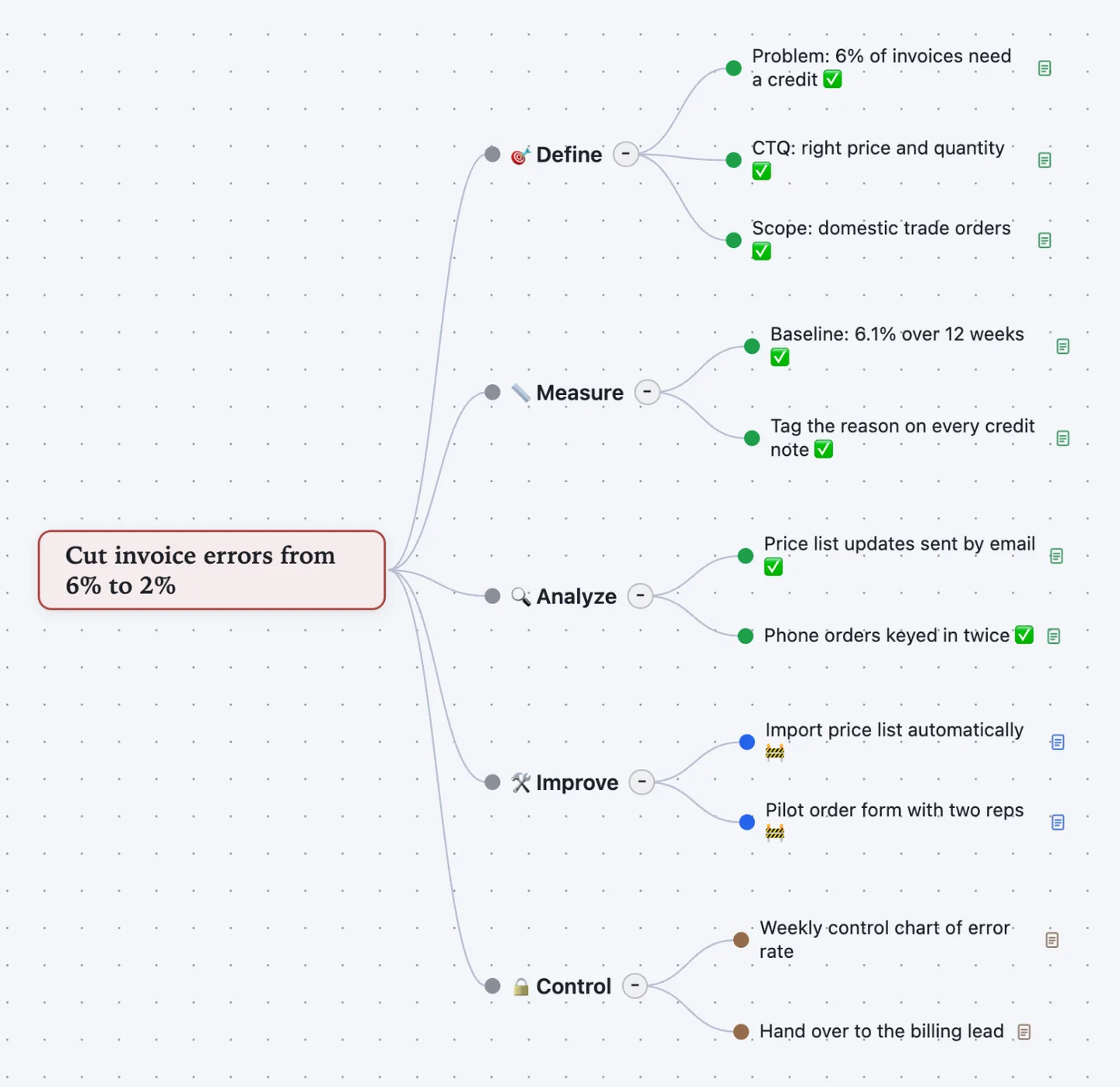
One map, five phases. Define to Control on one page. Anyone can see what is done and what is blocked.
Ready for each tollgate. Each deliverable carries its evidence. The sponsor reviews the phase on the map itself.
Hand it over. The control plan and the owner sit on the same map as the cause they protect. Export it as a PDF or slides.
How to run a DMAIC project, step by step
DMAIC is the improvement cycle of Six Sigma, the quality method Motorola built in the 1980s. It fixes an existing process that misses its target. Each phase ends at a tollgate: a review where the sponsor checks the work and decides whether to go on.
- Define the problem. Write a project charter: the problem, the goal, the scope and the team. List the CTQs. A CTQ (critical to quality) is what the customer needs from the process, stated so you can measure it.
- Measure the baseline. Decide what data to collect and how. Check that the measurement itself is reliable. Then record how the process performs today.
- Analyze the causes. List possible causes with a fishbone or a 5 whys. Test them against the data. Keep only the causes the data confirms.
- Improve the process. Pick fixes for the confirmed causes. Try them in a small pilot first. Compare the result with the baseline.
- Control the gain. Write a control plan: what to monitor, how often, and what to do if it slips. A control chart is the usual tool.
- Hand over and close. Give the process owner the control plan. Record the result and the lessons. Close the project at the last tollgate.
Worked example: invoice errors
A small wholesaler sends too many wrong invoices. Each one needs a credit note and a phone call. The team runs a DMAIC project. This is the map shown above, mid-way through Improve.
- 🎯 Define
- Problem: 6% of invoices need a creditOwner: Priya · Status: Done
- CTQ: right price and quantityStatus: Done
- Scope: domestic trade ordersStatus: Done · Evidence: Charter signed at tollgate 1
- 📏 Measure
- Baseline: 6.1% over 12 weeksStatus: Done · Evidence: 1,840 invoices, Jan–Mar
- Tag the reason on every credit noteOwner: Priya · Status: Done
- 🔍 Analyze
- Price list updates sent by emailStatus: Done · Evidence: Pareto: 58% of errors are price
- Phone orders keyed in twiceStatus: Done · Evidence: Pareto: 27% are quantity
- 🛠️ Improve
- Import price list automaticallyOwner: Tom · Status: In progress
- Pilot order form with two repsOwner: Lena · Status: In progress · Due date: 2026-12-05
- 🔒 Control
- Weekly control chart of error rateOwner: Priya · Status: Not started
- Hand over to the billing leadStatus: Not started
The Analyze branch names two causes, each with its Pareto share. Each Improve item answers one of them. Control is still empty, and the map shows it.
Let ChatGPT or Claude draft it
Connect Atlas Red to ChatGPT or Claude once. It is free. Then ask:
Make a DMAIC project map in Atlas Red for this problem: [describe the process and the gap]. Use the DMAIC template, fill in Define and Measure, and list the data we need for Analyze.
You get the same template, filled in, in your own account. Fix what it got wrong by hand. Or ask for another round.
Questions people ask
What is the DMAIC process?
A five-phase cycle to improve an existing process: Define, Measure, Analyze, Improve, Control. It is the core of Six Sigma. Each phase ends at a tollgate review before the next begins.
What goes in a DMAIC template?
The five phases and their deliverables. Define holds the charter, the problem statement and the CTQs. Measure holds the baseline and the data plan. Analyze holds the confirmed root causes. Improve holds the fixes and the pilot. Control holds the control plan and the handover.
What is a tollgate in the DMAIC methodology?
A review at the end of a phase. The team shows its deliverables to the sponsor or champion. The sponsor decides to go on, rework the phase, or stop. In this template, the Evidence field holds what you show at each tollgate.
Is this DMAIC template free?
Yes. It is part of Atlas Red's Free edition: up to 10 maps, kept with no end date, every export included, no credit card. Pro is a one-time $99 payment for unlimited maps.
Can I export the DMAIC template to PowerPoint, Excel or Word?
Not as a .pptx, .xlsx or .docx file. Every edition exports slides, PDF, PNG, JPEG and SVG images, an interactive web page, Markdown, OPML and plain text. Markdown keeps fields as "Label: value" lines and pastes into Word or Google Docs.
Can ChatGPT or Claude help with a DMAIC project?
They can draft the map. Connect Atlas Red to ChatGPT or Claude and describe the process. It builds the map from this template in your workspace. The data and the tollgate decisions stay with your team.
DMAIC vs PDSA — what is the difference?
DMAIC is a longer project with fixed phases and tollgates. It suits a process problem that needs data to find the cause. PDSA (Plan, Do, Study, Act) is a short test cycle. Quality improvement teams run many PDSA cycles from a driver diagram.